
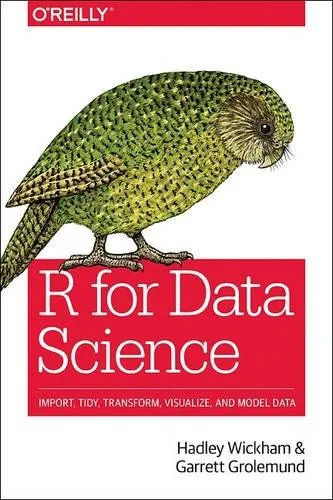
R for Data Science: Import, Tidy, Transform, Visualize, and Model Data
Hadley Wickham,Garrett Grolemund
2017
View book
Book guide and evaluation
ChengXiang Zhai
0 reviews
Published
pages
views
Welcome to the comprehensive guide to understanding the nuances of statistical language models in the fascinating field of information retrieval. This book, "Statistical Language Models for Information Retrieval," delves deep into the core concepts and methodologies that ha
Before you read
Welcome to the comprehensive guide to understanding the nuances of statistical language models in the fascinating field of information retrieval. This book, "Statistical Language Models for Information Retrieval," delves deep into the core concepts and methodologies that have transformed the landscape of how we retrieve and process information in the digital age.
The book begins by laying the historical foundation of statistical language models, tracing their evolution from basic theoretical constructs to sophisticated algorithms capable of handling vast amounts of text data. The initial chapters introduce the fundamentals of language modeling, including probability theory, statistical estimation, and the key principles that underpin the retrieval process in information systems.
Midway, the book transitions into exploring various types of language models, such as uni-gram, bi-gram, and more complex N-gram models, investing significant attention in illustrating their practical applications. It rigorously examines the use of language models in query expansion, document scoring, and relevance feedback, highlighting their pivotal role in enhancing search engine performance and user satisfaction.
The latter chapters are dedicated to advanced topics such as smoothing techniques and the integration of language models with machine learning algorithms. The book not only guides readers through these advanced topics but also encourages the development of new models and algorithms, providing a robust framework for future research and development in the field.
By the end of "Statistical Language Models for Information Retrieval," readers will have gained:
The book is replete with insightful observations and thought-provoking quotes. Here are a few notable ones:
"Language models are the bedrock of modern information retrieval, steering the way we search, find, and understand information."
"In the ocean of digital information, statistical language models act as a compass, guiding our search to uncover relevant and meaningful content."
The significance of this book lies in its comprehensive coverage of both foundational and advanced concepts, making it an indispensable resource for students, researchers, and practitioners alike. As information retrieval systems continue to integrate more deeply into our daily lives and evolve with advancements in artificial intelligence, the principles covered in this book remain critically relevant.
"Statistical Language Models for Information Retrieval" matters because it not only educates but also inspires innovation. By intertwining theoretical insights with practical challenges, the book offers a holistic view that equips readers with the tools necessary to push the boundaries of what is possible in information retrieval.
Your question is answered in the context of this title and author. Each answer uses 2 points.
0 reviews, 4.5 average out of 5
Sign in to publish a review.
Ask a focused question and learn from the community.
Related references that continue this learning path.
Hadley Wickham,Garrett Grolemund
Deepti Chopra,Nisheeth Joshi,Iti Mathur