

SOFTWARE ARCHITECTURE WITH C# 10 AND .NET 6 : develop software solutions using... microservices, devops, ef core, and design pattern.
GABRIEL ABBRUZZESE FRANCESCO BAPTISTA
2022
View book
Book guide and evaluation
Laurent Besacier,Adrian-Horia Dediu,Carlos Martín-Vide (eds.)
0 reviews
Published
pages
views
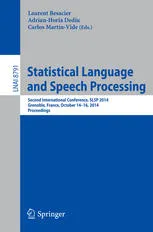
Introduction to 'Statistical Language and Speech Processing: Second International Conference, SLSP 2014, Grenoble, France, October 14-16, 2014, Proceedings' In recent years, the field of statistical language and speech processing has see
Before you read
In recent years, the field of statistical language and speech processing has seen a significant transformation. This profound change stems from the vast array of computational techniques and tools that continue to emerge and evolve. The proceedings from the Second International Conference on Statistical Language and Speech Processing (SLSP 2014), held in Grenoble, France, offer a comprehensive view of contemporary advancements and insights in this crucial field. This book is a meticulously curated collection of research papers and innovative contributions that exemplify the cutting-edge work being conducted in statistical language processing.
'Statistical Language and Speech Processing: SLSP 2014' is a collection of peer-reviewed research papers presented at the conference in Grenoble. It encapsulates a wide range of topics relevant to statistical approaches to language and speech processing. This book introduces novel frameworks, algorithms, and approaches, bridging theoretical underpinnings with practical implementations. The papers cover various domains, including but not limited to, text analysis, speech recognition, and language modeling. As the community seeks to advance communication technologies, this compilation serves as a critical platform for exchanging knowledge and fostering innovation.
The key takeaways from this book are multifaceted. The proceedings emphasize the importance of leveraging statistical methodologies to enhance the performance and accuracy of language and speech processing systems. A recurrent theme is the integration of machine learning techniques, particularly neural networks and deep learning, which have revolutionized the field. The book also highlights challenges such as handling large datasets and improving the naturalness of human-computer interaction. The research insights provided will empower scholars, engineers, and practitioners to develop more advanced and intuitive language technologies.
While the nature of conference proceedings means fewer direct quotes, certain recurring statements emerge through the collective contributions. Phrases such as "innovation through collaboration" and "harnessing the power of data" reflect the conference's spirit. These encapsulate the motivation behind advancements in statistical language processing, driving further research and exploration of emerging paradigms.
This book captures a pivotal moment in the evolution of language and speech processing technologies. It matters because it not only documents emerging trends and techniques but also serves as a reference for future research. As technology continues to advance, the information encapsulated in these proceedings will remain a cornerstone for academia and industry professionals. With its strong emphasis on statistical methods, it lays the groundwork for the ongoing development of applications that will enrich human-machine interaction. By fostering cross-disciplinary dialogue, 'Statistical Language and Speech Processing: SLSP 2014' enkindles the pursuit of knowledge and inspires the next generation of breakthroughs in the field.
Your question is answered in the context of this title and author. Each answer uses 2 points.
0 reviews, 4.9 average out of 5
Sign in to publish a review.
Ask a focused question and learn from the community.
Related references that continue this learning path.
GABRIEL ABBRUZZESE FRANCESCO BAPTISTA

Gabriel Baptista,Francesco Abbruzzese

Limin Jia,Zhigang Liu,Yong Qin,Rongjun Ding,Lijun Diao (eds.)