Book guide and evaluation
Stanford-Cambridge program
Gary Mavko, Tapan Mukerji, Jack Dvorkin
English
Unordered
Computer Science and Theory
4.8 / 5
0 reviews
1998
Published
340 / 339
pages
102
views
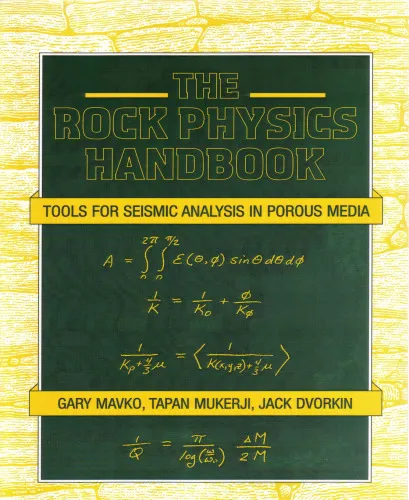
The Rock Physics Handbook conveniently brings together the theoretical and empirical relations that form the foundations of rock physics, with particular emphasis on seismic properties. It also includes commonly used models and relations for electrical and dielectric rock propert
Before you read
What will you get from this book?
The Rock Physics Handbook conveniently brings together the theoretical and empirical relations that form the foundations of rock physics, with particular emphasis on seismic properties. It also includes commonly used models and relations for electrical and dielectric rock properties. Seventy-six articles concisely summarize a wide range of topics, including wave propagation, AVO-AVOZ, effective media, poroelasticity, pore fluid flow and diffusion. The book contains overviews of dispersion mechanisms, fluid substitution, and Vp-Vs relations. Useful empirical results on reservoir rocks and sediments, granular media, tables of mineral data, and an atlas of reservoir rock properties complete the text. This distillation of an otherwise scattered and eclectic mass of knowledge is presented in a form that can be immediately applied to solve real problems. Geophysics professionals, researchers and students as well as petroleum engineers, well log analysts, and environmental geoscientists will value[...]The Rock Physics Handbook as a unique resource.
Ask this book
Your question is answered in the context of this title and author. Each answer uses 2 points.
Sign in to ask the book assistant.
Reader reviews
0 reviews, 4.8 average out of 5
No reviews yet
If you have read this book, help the next reader with your experience.
Write a review
Sign in to publish a review.
Reader questions and answers
Ask a focused question and learn from the community.
Sign in to ask or answer a question.
No questions yet
Be the first to ask a clear, useful question.
What to read next
Related references that continue this learning path.