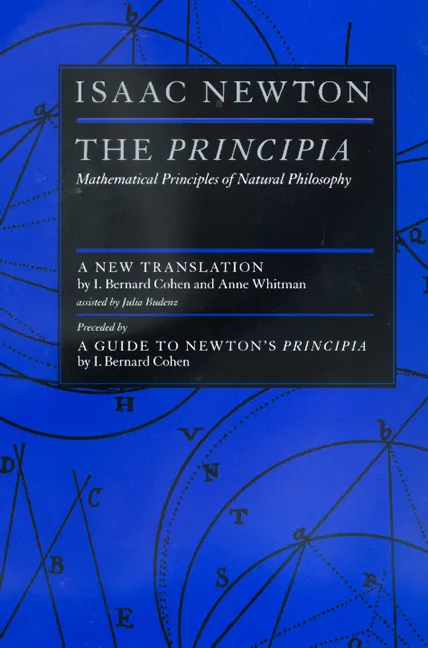
The Principia: Mathematical Principles of Natural Philosophy
Isaac Newton,I. Bernard Cohen,Anne Whitman,Julia Budenz
1999
View book
Book guide and evaluation
Rainer Dick (author)
0 reviews
Published
pages
views
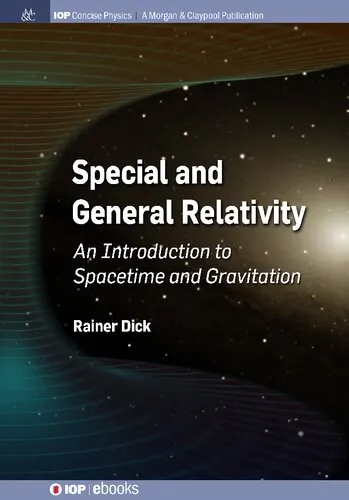
Introduction Welcome to an exciting journey through the realms of modern physics! Special and General Relativity: An Introduction to Spacetime and Gravitation, authored by yours truly, was crafted with the mission to illuminate one of the most fascinating achievements of
Before you read
Welcome to an exciting journey through the realms of modern physics! Special and General Relativity: An Introduction to Spacetime and Gravitation, authored by yours truly, was crafted with the mission to illuminate one of the most fascinating achievements of human thought: Einstein's theory of relativity. This book is an accessible yet comprehensive exploration of the principles, mathematics, and profound implications that form the foundation of special and general relativity.
This introduction will guide prospective readers through the core essence of the book, highlighting its key content. Whether you're a budding physicist, a curious student, or an enthusiast of science, this book strives to make relativity accessible without skipping over the rigor that makes it revolutionary. By the end of this introduction, you'll understand why this book matters and what makes relativity such an enduringly captivating subject.
The book is divided into two main parts—special relativity and general relativity—each presented with escalating complexity to follow the reader's learning curve. The sequencing ensures a clear understanding of fundamental principles before venturing into deeper waters.
In the first part, special relativity, I introduce the postulates of relativity and their counter-intuitive yet experimentally validated outcomes: time dilation, length contraction, and the equivalence of mass and energy. These concepts are carefully unpacked with examples and problem sets designed for self-study. The discussion extends to the spacetime interval, Minkowski diagrams, and the nature of causality—concepts that prepare readers for the more complex arena of general relativity.
In the second part, general relativity, we step into the world of curved spacetime. Starting with the equivalence principle, the book develops the Einstein field equations step by step, explaining each term and its physical meaning. Applications of these equations are explored, including black holes, gravitational waves, and cosmological models of the universe. Advanced mathematical tools like tensors and geodesics are introduced with sufficient groundwork to make them approachable.
Throughout, the book weaves in historical context, experimental confirmations, and modern implications, blending theory and practice to showcase how relativity impacts our understanding of the universe.
"The greatest triumph of science is not just in what it explains but in the clarity it brings to the questions that remain."
"Relativity reminds us of the elegance of nature—the same equations can describe time, space, and the fabric of the cosmos."
"Black holes are not just cosmic curiosities; they are laboratories testing the boundaries of knowledge itself."
This book stands out for its clarity, rigor, and accessibility. Relativity isn't just abstract science—it's the cornerstone of everything from cosmology to daily technologies like GPS. Yet the elegance of relativity is often buried under the weight of mathematics and jargon. My goal in writing this book was to bridge this gap, presenting relativity's core ideas in a way that welcomes curious minds while maintaining scientific precision.
The book also mirrors the progression of knowledge in the field, presenting relativity both as a product of its historical moment and as a living science. In today’s world, where cutting-edge research continues to reveal gravitational waves and probe the edges of black holes, understanding relativity feels more relevant than ever.
Readers will gain not only knowledge of relativity’s principles but an appreciation of how science continuously builds upon itself, challenging and refining our understanding of the universe. Whether you're heading into a career in science or simply want to appreciate the profound beauty of the cosmos, this book offers tools to engage with one of the greatest achievements of human thought.
Your question is answered in the context of this title and author. Each answer uses 2 points.
0 reviews, 4.6 average out of 5
Sign in to publish a review.
Ask a focused question and learn from the community.
Related references that continue this learning path.
Isaac Newton,I. Bernard Cohen,Anne Whitman,Julia Budenz