

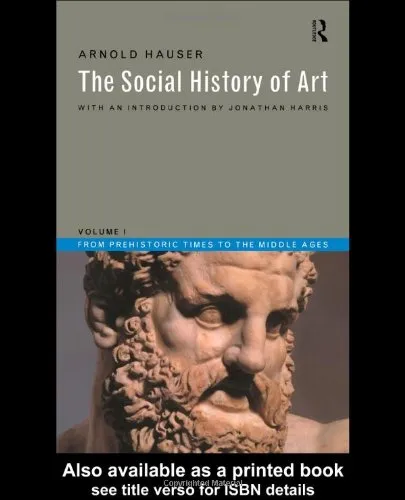
Book guide and evaluation
Social History of Art, Boxed Set: The Social History of Art: From Prehistoric Times to the Middle Ages
Arnold Hauser
English
Beginner
Art History
4.5 / 5
0 reviews
1999
Published
199
pages
435
views
Introduction Welcome to "Social History of Art, Boxed Set: The Social History of Art: From Prehistoric Times to the Middle Ages" by Arnold Hauser, a seminal work that offers an insightful exploration into the intersection of art and society. This comprehensive
Before you read
What will you get from this book?
Introduction
Welcome to "Social History of Art, Boxed Set: The Social History of Art: From Prehistoric Times to the Middle Ages" by Arnold Hauser, a seminal work that offers an insightful exploration into the intersection of art and society. This comprehensive volume delves into the profound connections between artistic expression and the cultural, economic, and political contexts from which they emerge.
Detailed Summary of the Book
Arnold Hauser's 'Social History of Art' meticulously outlines the development of art from its earliest forms found in the prehistoric era to the intricate creations of the Middle Ages. The book is structured to offer a chronological journey, providing a detailed lens through which readers can view the evolution of artistic styles juxtaposed with historical events and societal changes.
Hauser starts by examining prehistoric art, exploring how early humans expressed their realities and beliefs through cave paintings and carvings. This is not only a study of techniques but an exploration of human consciousness and its earliest expressions through visual means.
As we progress, Hauser elaborates on the art of ancient civilizations, such as Mesopotamia, Egypt, Greece, and Rome, examining their distinctive styles and the societal structures that influenced them. He argues that art is a reflection of the hierarchy, religion, and daily life experienced by these societies.
The narrative then shifts towards the Middle Ages, a period often seen as a transformative bridge between ancient and modern times. During this epoch, Hauser explains how art was predominantly shaped by the Church and feudal systems, yet was still remarkably innovative, laying the groundwork for the later periods of the Renaissance and beyond.
Key Takeaways
- Art is a profound reflection of the social, political, and religious dynamics of its time.
- Understanding the context in which art is created enriches our interpretation of the work itself.
- Historical events and societal shifts play a crucial role in the evolution of artistic styles and methods.
- Art serves as both a mirror and a molder of societal values and beliefs throughout history.
Famous Quotes from the Book
"Art is not only a mirror of social reality but also a means of shaping it."
"Every work of art is a child of its age, and, in many cases, the mother of our emotions."
Why This Book Matters
The complexity and length of human history demand works like Hauser's 'Social History of Art', which systematically dissects the inextricable link between society and artistic expression. This book is indispensable for students, historians, and art enthusiasts who wish to comprehend how art is a product of its socio-historical environment.
By providing a detailed and critical examination of art's social dimensions, Hauser's work challenges readers to look beyond aesthetics and to understand the driving forces behind art creation. Through this understanding, we are better equipped to appreciate art as a dynamic part of human culture and history.
The "Social History of Art" reshapes our appreciation and understanding of art history as not just a series of stylistic changes, but as an ongoing dialogue between artists and their world — making Arnold Hauser’s work timeless and essential.
Ask this book
Your question is answered in the context of this title and author. Each answer uses 2 points.
Sign in to ask the book assistant.
Reader reviews
0 reviews, 4.5 average out of 5
No reviews yet
If you have read this book, help the next reader with your experience.
Write a review
Sign in to publish a review.
Reader questions and answers
Ask a focused question and learn from the community.
Sign in to ask or answer a question.
No questions yet
Be the first to ask a clear, useful question.
What to read next
Related references that continue this learning path.


Social History of Art, Boxed Set: The Social History of Art: Rococo, Classicism and Romanticism
Arnold Hauser,Jonathan Harris
1999
View book