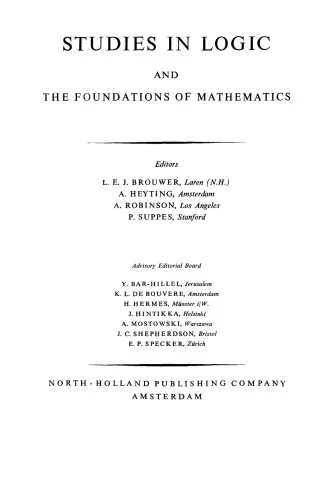
Formal Systems and Recursive Functions: Proceedings of the Eighth Logic Colloquium, Oxford, July 1963
John N. Crossley,Michael Dummett (editors)
1965
View book
Book guide and evaluation
Grigori Mints
0 reviews
Published
pages
views
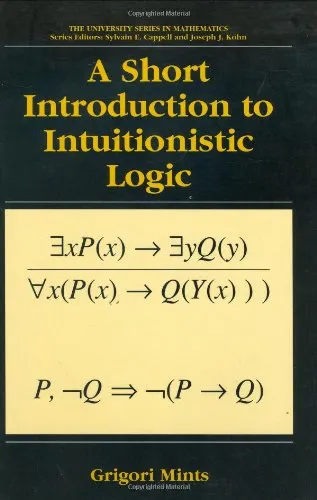
Welcome to an in-depth overview of the book 'Short Introduction to Intuitionistic Logic' by Grigori Mints. This text serves as a guiding beacon for those delving into the world of intuitionistic logic, offering a comprehensive exploration of its principles, methodologies, and p
Before you read
Welcome to an in-depth overview of the book 'Short Introduction to Intuitionistic Logic' by Grigori Mints. This text serves as a guiding beacon for those delving into the world of intuitionistic logic, offering a comprehensive exploration of its principles, methodologies, and philosophical implications.
In 'Short Introduction to Intuitionistic Logic', Grigori Mints provides an accessible yet profound insight into the nuances of intuitionistic logic—a branch of logic that emerges from the constructive approach to mathematics and philosophy. Unlike classical logic, intuitionistic logic does not accept the law of the excluded middle, which states that every proposition is either true or false. Instead, it requires evidence or constructive proofs. The book is organized to guide readers through the foundational concepts, beginning with the historical emergence of intuitionism and its divergence from classical logic. The initial chapters introduce Brouwer and Heyting, the pioneers of this logical viewpoint, and establish the core principles of constructivism in mathematics.
As the book progresses, Mints elucidates the technicalities of intuitionistic logic, including its syntax and semantics. Key elements such as Kripke models are explored, providing readers with tools to understand how truth values may evolve across possible worlds. The author also addresses the role of proof theory and discusses how intuitionistic logic's emphasis on proof transformations contributes to a deeper understanding of computational processes. Furthermore, the book explores applications in computer science, especially regarding programming languages and type theories, where intuitionistic logic underpins functional programming paradigms.
“To understand intuitionistic logic, one must first shed the comfort of absolutes in truth—its embrace requires an acceptance of truth as a construct of evidence and proof.”
“In the world of intuitionistic logic, every proposition holds the potential to be true, yet its truth is only blossomed by the light of constructive proof.”
This book is significant for several reasons. It introduces readers to a form of logic that challenges traditional views, fostering a more nuanced understanding of truth and reasoning. This paradigm is particularly relevant in the contemporary context, where computer science and mathematics are increasingly interconnected. The nature of proof and constructivity in logic informs how we develop algorithms and code, shaping the evolution of technology and computational theory. In addition, 'Short Introduction to Intuitionistic Logic' is a testament to Grigori Mints' ability to distill complex topics into approachable content, making it an essential resource for students, educators, and professionals alike.
For those interested in the philosophical underpinnings of mathematics, the book provides a compelling narrative about the development of logical thought. It serves as a catalyst for discussions about the foundations of knowledge and the nature of proof, encouraging a reflective approach to understanding and applying logic. Whether you are an aspiring logician, a software engineer, or simply a curious reader, this book offers valuable insights and fosters an appreciation for the intricacies of intuitive thought.
Your question is answered in the context of this title and author. Each answer uses 2 points.
0 reviews, 4.0 average out of 5
Sign in to publish a review.
Ask a focused question and learn from the community.
Related references that continue this learning path.
John N. Crossley,Michael Dummett (editors)