Book guide and evaluation
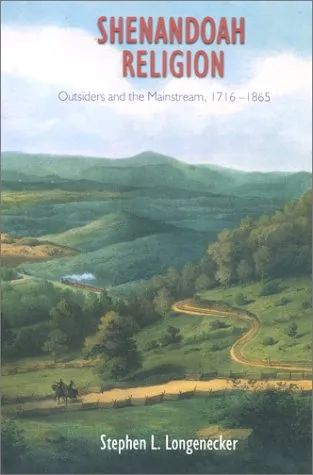
Shenandoah Religion: Outsiders and the Mainstream, 1716-1865
Stephen,L. Longenecker
English
Intermediate
novel
3.3 / 5
0 reviews
2002
Published
262
pages
605
views
Introduction to "Shenandoah Religion: Outsiders and the Mainstream, 1716-1865" "Shenandoah Religion: Outsiders and the Mainstream, 1716-1865" provides a comprehensive exploration of the complex religious landscape of the Shenandoah Valley from colonial times throug
Before you read
What will you get from this book?
Introduction to "Shenandoah Religion: Outsiders and the Mainstream, 1716-1865"
"Shenandoah Religion: Outsiders and the Mainstream, 1716-1865" provides a comprehensive exploration of the complex religious landscape of the Shenandoah Valley from colonial times through the Civil War. Authored by Stephen L. Longenecker, this seminal work delves into the interactions and developments between peripheral religious groups and the dominant cultural institutions in the Shenandoah Valley, presenting a unified narrative that encapsulates nearly 150 years of religious transformation.
Detailed Summary of the Book
The book meticulously examines the evolution of religious diversity in the Shenandoah Valley, a region marked by its rich tapestry of belief systems and cultural exchanges. Beginning in 1716, when the region was largely a frontier, Longenecker traces how early European settlers brought with them a variety of religious traditions that both clashed and coalesced over time.
Throughout the narrative, Longenecker emphasizes the role of so-called "outsider" religious groups such as Anabaptists, Brethren, and Methodists, presenting them not merely as peripheral entities but crucial elements that both challenged and were absorbed into the dominant Anglican (later Episcopal) mainstream. The dynamic interactions among these faiths, coupled with the valley's geographical isolation, created an environment where religious diversity could flourish and evolve.
As the book progresses through the Revolutionary and Civil Wars, Longenecker notes how these conflicts intensified religious identities and fostered a sense of community among the faithful, transforming the Shenandoah Valley into a microcosm of American religious life during the era. The blending of cultures and beliefs led to a distinctive regional spirituality that would have implications beyond the Civil War era.
Key Takeaways
- The Shenandoah Valley was both a cradle and crucible for religious pluralism in early America, hosting a remarkable array of sects and denominations.
- Religious outsiders played a crucial role in shaping broader religious culture in the valley, influencing mainstream practices and beliefs despite initial marginalization.
- The tumultuous periods of war and conflict served as catalysts for religious transformation, solidifying and spreading the valley's unique blend of spiritual beliefs.
- The book argues that understanding regional religious history is essential for comprehending the broader narratives of American religion.
Famous Quotes from the Book
"In the crucible of the valley's isolated mountains and fertile grounds, faiths collided, coalesced, and created a distinct religious culture that prefigured broader shifts in the American religious landscape."
"Outsiders at the valley's edges would shape its core, transforming from marginal figures to integral architects of its spiritual backbone."
Why This Book Matters
"Shenandoah Religion: Outsiders and the Mainstream, 1716-1865" is a crucial addition to the study of American religious history due to its regional focus, which allows for a nuanced understanding of how local dynamics contribute to national religious trends. Stephen L. Longenecker’s work sheds light on the often-overlooked roles of minority religious communities in shaping mainstream culture, providing valuable insights for scholars, historians, and religious enthusiasts alike.
The book is also significant for its methodological approach, combining robust archival research with sociocultural analysis to offer readers an in-depth view of the vibrant religious life in one of America’s most storied regions. Its exploration of the valleys' spiritual transformations provides a template for studying the interplay between religion, culture, and history in a variety of contexts.
Ask this book
Your question is answered in the context of this title and author. Each answer uses 2 points.
Sign in to ask the book assistant.
Reader reviews
0 reviews, 3.3 average out of 5
No reviews yet
If you have read this book, help the next reader with your experience.
Write a review
Sign in to publish a review.
Reader questions and answers
Ask a focused question and learn from the community.
Sign in to ask or answer a question.
No questions yet
Be the first to ask a clear, useful question.
What to read next
Related references that continue this learning path.
The Ring and the Cross: Christianity and the Lord of the Rings
Paul E. Kerry,Nils Ivar Agoy,Bradley J. Birzer,Jason Boffetti,Marjorie Burns,Carson L. Holloway,John R. Holmes,Ronald Hutton,Catherine Madsen,Chris Mooney,Stephen Morillo,Joseph Pearce,Michael Tomko,Ralph C. Wood
2010
View book
The Grand Inquisitor: with related chapters from The Brothers Karamazov
Fyodor Dostoevsky
1993
View book