Book guide and evaluation
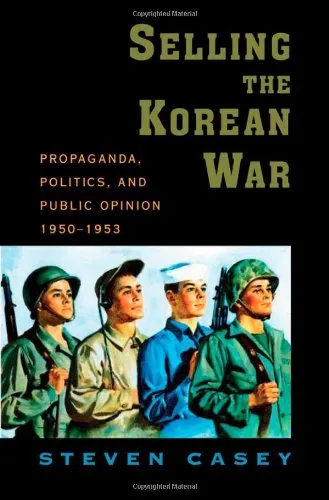
Selling the Korean War: Propaganda, Politics, and Public Opinion in the United States, 1950-1953
Steven Casey
English
Unordered
Politics
4.4 / 5
0 reviews
2008
Published
489
pages
263
views
Selling the Korean War: Propaganda, Politics, and Public Opinion in the United States, 1950-1953 Cold War propaganda, U.S. wartime public opinion An authoritative exploration of Selling the Korean War: Propaganda, Politics, and Public Opinion in the United States, 1950-1953.
Before you read
What will you get from this book?
Analytical Summary
“Selling the Korean War: Propaganda, Politics, and Public Opinion in the United States, 1950-1953” is a thorough and critical examination of how the American government, political leaders, and media sought to explain, justify, and sustain public support for U.S. involvement in Korea during the early Cold War era.
Set against the backdrop of shifting global power dynamics following World War II, the book dissects the interplay between official rhetoric, the mechanics of propaganda, and the realities of public opinion. As author Steven Casey methodically illustrates, Washington faced the challenge of framing a distant, complex conflict in a manner that resonated with domestic audiences who were weary of war but wary of communism’s spread.
Through meticulous archival research, primary sources, and contextual analysis, the narrative traces decisions from the Truman administration through the Eisenhower years, explaining how political imperatives shaped messaging strategies. It also examines how news media amplified certain frames, how dissenting voices struggled for airtime, and how evolving battlefield conditions affected official narratives. The result is both a history of the Korean War’s public presentation and a case study in the larger phenomenon of Cold War propaganda.
Key Takeaways
Readers will gain detailed insight into the mechanisms and challenges of wartime communication in a democracy under ideological pressure.
One key takeaway is that the Korean War was never “sold” in a vacuum; it drew upon established Cold War tropes that portrayed U.S. actions as defending freedom and halting aggression.
Another is the recognition of the role that fluctuating public opinion played in shaping, constraining, or encouraging policy choices — an ever-present feedback loop between the electorate and the political establishment.
The book also clarifies the enduring relevance of these historical lessons, showing how modern conflicts are communicated using similar strategies, albeit with updated channels and technologies.
Memorable Quotes
“In times of conflict, the battle for hearts and minds can be as decisive as the battle on the field.” Unknown
“Propaganda is not merely about persuasion; it is about framing reality itself.” Unknown
“Public opinion is a weapon politicians wield — but it can also be a force they struggle to control.” Unknown
Why This Book Matters
Understanding how the Korean War was presented to the American public offers profound lessons for anyone studying media, politics, or conflict.
This work matters because it illuminates the historical foundations of modern governmental communication. It shows how Cold War propaganda operated in a constitutional democracy, balancing — and sometimes bending — freedoms to meet strategic aims.
For academics, political communicators, journalists, and historians, “Selling the Korean War: Propaganda, Politics, and Public Opinion in the United States, 1950-1953” is an indispensable case study. It captures the tensions between truth-telling and persuasion, between free debate and national security, and between policy action and the public's willingness to bear its costs.
Inspiring Conclusion
“Selling the Korean War: Propaganda, Politics, and Public Opinion in the United States, 1950-1953” offers a powerful reminder of how historical narrative, media influence, and political imperatives intersect.
By exploring the methods used to engage, shore up, and sometimes manipulate public sentiment, the book equips readers with analytical tools for understanding how wars are explained and justified. In today’s era of rapid information exchange, these lessons resonate more than ever.
Whether you are an academic researcher, a policy analyst, or simply someone interested in the history of American political communication, this study’s insights invite discussion, debate, and deeper inquiry. Read it, share its perspectives, and join the conversation about how past experiences can inform future approaches to conflict communication.
Ask this book
Your question is answered in the context of this title and author. Each answer uses 2 points.
Sign in to ask the book assistant.
Reader reviews
0 reviews, 4.4 average out of 5
No reviews yet
If you have read this book, help the next reader with your experience.
Write a review
Sign in to publish a review.
Reader questions and answers
Ask a focused question and learn from the community.
Sign in to ask or answer a question.
No questions yet
Be the first to ask a clear, useful question.
What to read next
Related references that continue this learning path.