
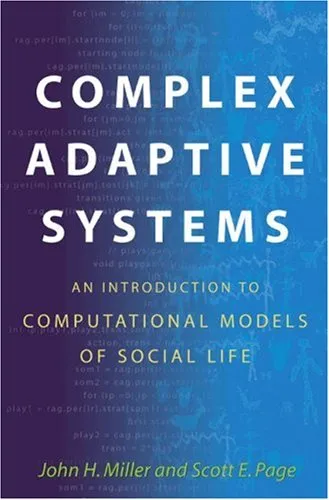
Complex Adaptive Systems: An Introduction to Computational Models of Social Life (Princeton Studies in Complexity)
John H. Miller,Scott E. Page
2007
View book

Book guide and evaluation
Juan C. Burguillo (auth.)
0 reviews
Published
pages
views
Introduction Modern societies face increasing levels of complexity, whether in economics, social dynamics, or environmental systems. To address such challenges, multidisciplinary approaches that integrate advanced modeling techniques and theoretical frameworks have
Before you read
Modern societies face increasing levels of complexity, whether in economics, social dynamics, or environmental systems. To address such challenges, multidisciplinary approaches that integrate advanced modeling techniques and theoretical frameworks have become indispensable. Self-organizing Coalitions for Managing Complexity: Agent-based Simulation of Evolutionary Game Theory Models using Dynamic Social Networks for Interdisciplinary Applications represents an innovative effort to analyze and manage these complexities through a combination of evolutionary game theory, agent-based simulations, and dynamic social networks. This book bridges the gap between theory and practical insights, making it suitable for researchers, data scientists, and practitioners across a wide range of domains.
This book delves into the principles of self-organization and cooperative behavior by studying how coalitions form, evolve, and adapt within complex systems. Using agent-based modeling as a key tool, it demonstrates dynamic interactions among agents in diverse social and environmental scenarios. Readers will find that this is not just a theoretical guide but also a practical resource for building computational models to better understand emergent phenomena in real-world systems.
At its core, this book explores how self-organizing behavior emerges in complex systems. It starts with an introduction to game theory fundamentals, focusing on evolutionary concepts and their relevance to modeling real-world interactions. By incorporating agent-based simulations, the book offers a unique vantage point for understanding individual-level decision-making processes and their aggregate impacts on societal-level dynamics.
The second part of the book focuses on dynamic social networks. It examines how network topology influences cooperation, competition, and coalition formation. By combining these principles with agent-based modeling and game theory, readers can see how the fluid nature of relationships within networks impacts the overall system.
Practical applications are emphasized throughout the book, with case studies illustrating the use of these models in solving interdisciplinary problems. Applications range from understanding economic markets and resource allocation to tackling issues in sociology, political science, and environmental studies. Moreover, the comparison between theoretical predictions and observed data ensures that readers can bridge the often-overlooked gap between simulation and reality.
"In the face of complexity, it is self-organization, not rigid control, that offers the best chance for adaptation and survival in changing environments."
"Coalitions are not simply the sum of their parts; they are dynamic ecosystems where individual choices converge to produce emergent order."
"Agent-based models do not just mimic reality; they serve as laboratories for understanding the intricate interplay of actors and structures in complex systems."
The importance of understanding and managing complexity cannot be overstated in today's world. Whether we look at global environmental challenges, evolving social dynamics, or intricate market systems, the need for robust analytical tools and frameworks is immediate. This book stands out as a practical and theoretical guide for anyone dealing with emergent phenomena in complex systems.
By integrating evolutionary game theory with cutting-edge simulation methods and the study of social networks, this work provides readers with powerful tools to approach real-world problems. For researchers, it offers a rigorous foundation for further exploration. For practitioners, it provides hands-on techniques that can be applied to diverse domains. As a result, this book is highly relevant to professionals in economics, sociology, political science, computational modeling, and many other fields.
In essence, Self-organizing Coalitions for Managing Complexity emphasizes that adaptation and cooperation are fundamental to navigating complexity. By focusing on how coalitions self-organize and evolve, this book brings critical insights into managing challenges that lie at the heart of our interconnected world.
Your question is answered in the context of this title and author. Each answer uses 2 points.
0 reviews, 4.0 average out of 5
Sign in to publish a review.
Ask a focused question and learn from the community.
Related references that continue this learning path.
John H. Miller,Scott E. Page
John N. Mordeson,Sunil Mathew,Davender S. Malik

Nicola Santoro (auth.),Alexander A. Shvartsman,Pascal Felber (eds.)

Evangelos Kranakis,Danny Krizanc (auth.),Paola Flocchini,Leszek Gąsieniec (eds.)