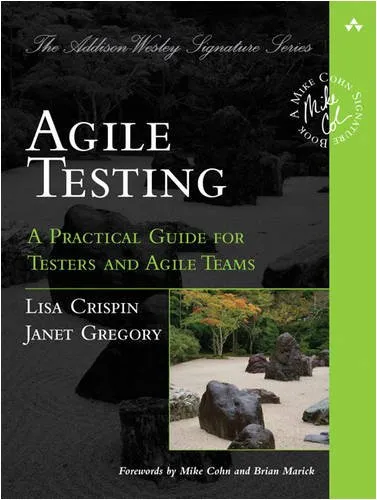
Agile Testing: A Practical Guide for Testers and Agile Teams
Lisa Crispin,Janet Gregory
2009
View book
Book guide and evaluation
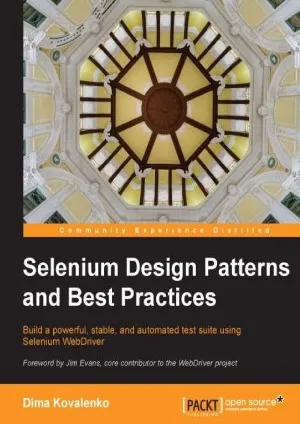
Dima Kovalenko
0 reviews
Published
pages
views
Introduction to Selenium Design Patterns and Best Practices Welcome to Selenium Design Patterns and Best Practices, a comprehensive guide crafted for testers and developers who aim to master Selenium. This book offers a detailed understanding of how to build maintainable
Before you read
Welcome to Selenium Design Patterns and Best Practices, a comprehensive guide crafted for testers and developers who aim to master Selenium. This book offers a detailed understanding of how to build maintainable, scalable, and highly effective test automation frameworks using Selenium.
If you have ever struggled to make your test automation efficient, stable, or easy to maintain, this book is here to guide you. Through a blend of design principles, actionable examples, and practical insights, you’ll gain the tools necessary to elevate your skills and deliver solid, reliable test automation for any project.
What’s inside this book?
In Selenium Design Patterns and Best Practices, we dive deep into strategies and techniques that ensure your automated tests are more than just scripts — they’re solid, re-usable pieces of your software lifecycle. The book starts with the fundamentals, like understanding Selenium and its ecosystem, before moving into the advanced design patterns that professional testers embrace every day.
Each chapter introduces a specific design pattern or principle, such as the Page Object Model, Command Pattern, Factory Pattern, and more. You’ll explore why these patterns matter, how they address common automation challenges, and how to implement them step by step. Alongside that, there are real-world examples and practices for improving test performance, choosing the right tools, and avoiding anti-patterns that often lead to brittle or bloated test frameworks.
Not just a technical deep dive, this book values practical advice just as much. You’ll find tips for integrating design principles into your workflow, collaborating with teams, and leveraging Selenium’s features to achieve greater efficiency.
"Automation is only valuable when it’s reliable. The true skill lies in designing tests that not only pass but endure the inevitable evolution of software."
"A good test framework, like code, should tell a story. It should read like documentation that explains both what it does and why it matters."
Modern testing requires more than just technical knowledge.
With software needs growing in complexity and speed, automated testing has become an essential skill for every developer and tester. However, it’s easy to fall into the trap of writing tests that are either fragile or impossible to maintain. That’s why this book is so important. It doesn’t just teach you how to use Selenium; it demonstrates how to do so with long-term success in mind.
Through years of industry experience, I’ve encountered the same issues at all levels of test automation. This book consolidates that knowledge into a powerful guide that can help you avoid those pitfalls and build frameworks that last. Whether you’re a beginner looking to get started or an experienced tester aiming to refine your skills, this book offers something for everyone.
By applying the design patterns and best practices outlined in this book, you’ll become a more confident, effective tester, capable of handling any automation challenge with clarity and precision.
Your question is answered in the context of this title and author. Each answer uses 2 points.
0 reviews, 4.0 average out of 5
Sign in to publish a review.
Ask a focused question and learn from the community.
Related references that continue this learning path.
Lisa Crispin,Janet Gregory
John D. McGregor,David A. Sykes