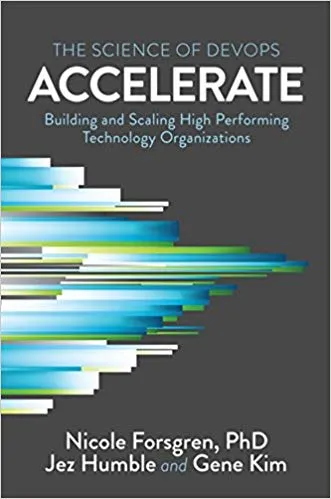
Accelerate: The Science of Lean Software and DevOps: Building and Scaling High Performing Technology Organizations
Nicole Forsgren;Jez Humble;Gene Kim
2018
View book
Book guide and evaluation
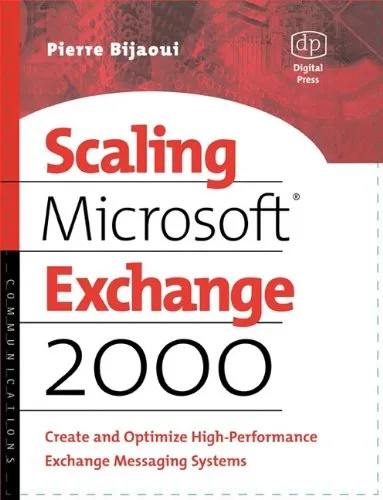
Pierre Bijaoui
0 reviews
Published
pages
views
Introduction to Scaling Microsoft Exchange 2000 Email has become an indispensable communication tool in modern organizations, and a robust messaging system is essential for maintaining productivity and efficiency. "Scaling Microsoft Exchange 2000: Create and
Before you read
Email has become an indispensable communication tool in modern organizations, and a robust messaging system is essential for maintaining productivity and efficiency. "Scaling Microsoft Exchange 2000: Create and Optimize High-Performance Exchange Messaging Systems" is a comprehensive guide designed to help IT professionals, system architects, and administrators build scalable, high-performance email systems using Microsoft Exchange 2000. From understanding the architectural foundations of Exchange to implementing advanced optimization techniques and troubleshooting problems, this book serves as an indispensable resource for anyone managing enterprise-level messaging systems.
As part of the Hewlett-Packard (HP) Technologies Series, this book blends theoretical guidance with practical, real-world solutions to deliver a complete roadmap for Exchange 2000 environments. It delves into the intricacies of scaling Exchange for growing businesses, ensuring that administrators can create messaging systems capable of handling increasing workloads without sacrificing performance or reliability.
Written with a focus on optimizing performance and enhancing system reliability, the book also aligns with best practices for architecture design, deployment, and maintenance. Whether you are an experienced Exchange administrator or new to the platform, this book equips you with the expertise required to maximize the potential of Exchange 2000.
"Scaling Microsoft Exchange 2000" is structured around key principles of scalability, reliability, and performance optimization, offering a step-by-step approach to building resilient messaging infrastructures. Starting with foundational concepts, the book explains the architectural design of Microsoft Exchange 2000, including its key components such as the Information Store, SMTP transport, and Active Directory integration.
It further explores the complexities of scaling Exchange environments, addressing the challenges of user population growth and increasing email traffic while providing strategies for storage management, server clustering, and enhanced security measures. The book also features detailed case studies to illustrate practical scenarios and best practices that can be adapted to different organizations.
Ongoing maintenance and troubleshooting are central topics as well, ensuring that administrators not only set up high-performing systems but also maintain their efficiency over time. Topics covered include monitoring tools, disaster recovery planning, and stress testing methodologies to evaluate system performance under heavy workloads.
With a blend of strategic insights, technical guidance, and hands-on lab exercises, the book ensures readers gain a 360-degree understanding of Exchange 2000.
"A messaging system is only as strong as its weakest link — identifying and addressing bottlenecks is the essence of scalable design."
"In the world of Exchange 2000, performance optimization is not merely a technical task; it is a mindset that demands foresight, planning, and continuous adaptation."
"Through rigorous testing and proactive maintenance, an administrator can transform a fragile infrastructure into a fortress of reliability and efficiency."
The relevance of "Scaling Microsoft Exchange 2000" transcends its era, as the principles of scalability, performance optimization, and system reliability remain universally applicable in IT environments. While Exchange 2000 may no longer be the centerpiece of modern enterprise messaging, much of its foundational architecture serves as the building blocks for subsequent iterations of Microsoft Exchange.
Beyond its technical significance, the book stands out for its balanced approach to theory and practice—empowering administrators to not only understand the "how" but also the "why" behind every decision. For organizations that continue to run legacy Exchange systems or those looking to better comprehend messaging infrastructure at scale, this book is an invaluable resource.
Furthermore, the book occupies a pivotal space for those studying the evolution of enterprise messaging systems, offering a snapshot of how organizations approached communication challenges at a pivotal moment in IT history. It is a must-read for any professional passionate about building, maintaining, and optimizing world-class messaging solutions.
Your question is answered in the context of this title and author. Each answer uses 2 points.
0 reviews, 4.0 average out of 5
Sign in to publish a review.
Ask a focused question and learn from the community.
Related references that continue this learning path.
Nicole Forsgren;Jez Humble;Gene Kim

Tim Roughgarden