
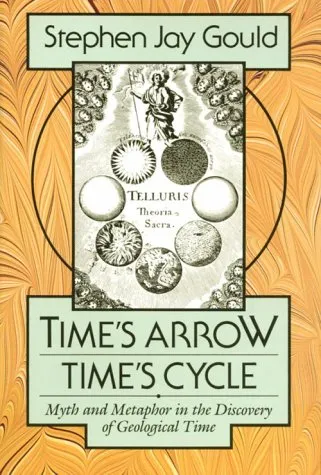
Time's Arrow, Time's Cycle: Myth and Metaphor in the Discovery of Geological Time
Stephen Jay Gould
1988
View book
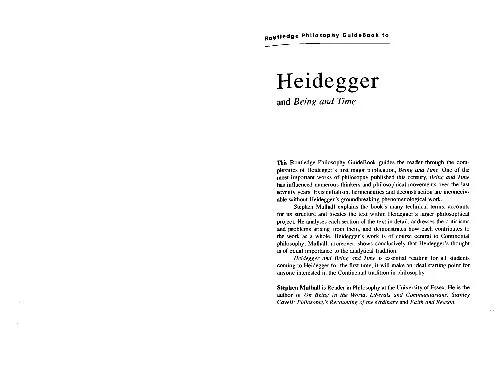
Book guide and evaluation
Stephen Mulhall (editor)
0 reviews
Published
pages
views
Welcome to the 'Routledge Philosophy GuideBook to Heidegger and Being and Time', an essential resource for anyone seeking a deeper understanding of one of the most profound and challenging works in continental philosophy, Martin Heidegger's 'Being and Time'. This guide is craft
Before you read
Welcome to the 'Routledge Philosophy GuideBook to Heidegger and Being and Time', an essential resource for anyone seeking a deeper understanding of one of the most profound and challenging works in continental philosophy, Martin Heidegger's 'Being and Time'. This guide is crafted to illuminate Heidegger's complex ideas and guide the reader through his existential exploration of being.
The 'Routledge Philosophy GuideBook to Heidegger and Being and Time' provides an in-depth exploration of Martin Heidegger's seminal work, 'Being and Time'. This guidebook is designed to unravel the dense and intricate philosophical inquiries that Heidegger presents. Heidegger's central theme of the work is the question of the meaning of being, an inquiry that challenges the fundamental structures of philosophy. 'Being and Time' is divided into two main sections: the first part delves into the analysis of Dasein, a term Heidegger uses to describe human existence, while the second explores time and temporality as the horizon for any understanding of being.
The guidebook examines Heidegger's designed framework for a phenomenological interpretation of existence and his shift from traditional metaphysics to a focus on language, temporality, and the human condition. It provides an elucidation of Heidegger's critique of previous philosophical approaches and his innovative philosophical style. Each chapter of the guidebook focuses on unpacking and discussing critical ideas and passages, assisting readers in navigating the complexities of Heidegger's thoughts and finding relevance to modern philosophical discourse.
“Being is the most universal concept and at the same time the most indefinable.”
“To be a human being means to be on the way.”
The 'Routledge Philosophy GuideBook to Heidegger and Being and Time' is critical for students, scholars, and anyone interested in twentieth-century philosophy. Heidegger's work has had an immense impact on virtually all areas of the humanities and social sciences. His thoughts on existence, temporality, and phenomenology disrupted traditional ways of thinking and laid the groundwork for existentialism, hermeneutics, and postmodernism. This guide is an indispensable tool, as it breaks down Heidegger’s dense philosophical language and complex ideas into accessible explanations and analyses.
For contemporary philosophers, intellectual historians, and conscious readers aiming to grapple with the profound question of what it means to be, this guidebook offers both a pathway and a companion on the challenging journey through Heidegger's 'Being and Time'. It not only illuminates Heidegger’s originality and innovation but also emphasizes the relevance of his inquiries to modern philosophical questions and challenges.
Your question is answered in the context of this title and author. Each answer uses 2 points.
0 reviews, 4.5 average out of 5
Sign in to publish a review.
Ask a focused question and learn from the community.
Related references that continue this learning path.
Stephen Jay Gould
Hubert L. Dreyfus
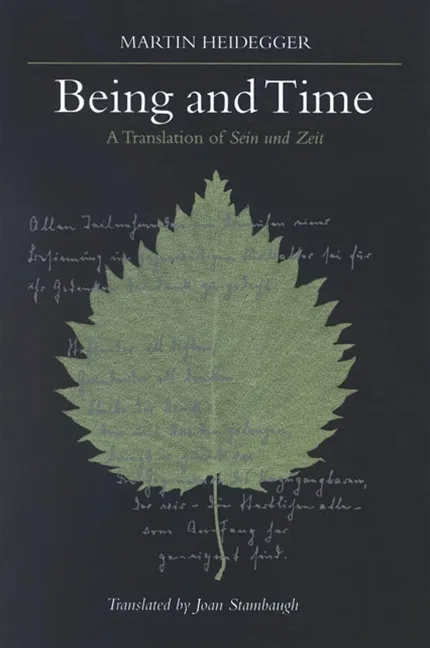
Martin Heidegger,Joan Stambaugh (translator)