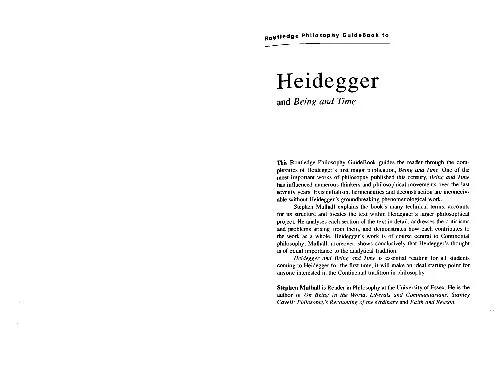
Routledge Philosophy GuideBook to Heidegger and Being and Time
Stephen Mulhall (editor)
1996
View book
Book guide and evaluation
Martin Heidegger,Joan Stambaugh (translator)
0 reviews
Published
pages
views
Being and Time: A Translation of Sein und Zeit Detailed Summary of the Book Martin Heidegger's "Being and Time" is a profound exploration into the nature of existence. Originally published in 1927, this seminal philosophical work challenges readers to rethink traditio
Before you read
Being and Time: A Translation of Sein und Zeit
Martin Heidegger's "Being and Time" is a profound exploration into the nature of existence. Originally published in 1927, this seminal philosophical work challenges readers to rethink traditional concepts of being. Translators like Joan Stambaugh have meticulously brought Heidegger's complex ideas into clear English, making his existential inquiries more accessible.
At its core, "Being and Time" delves into what it means "to be." Heidegger introduces the concept of Dasein, a German term that means "being there" or "existence," to deepen our understanding of human experience. This book does not just question what entities are but seeks to investigate the very sense of being itself. The way Heidegger approaches the question is revolutionary; instead of starting from metaphysical assumptions, he employs a descriptive phenomenological analysis of human life.
The book is split into two parts. The first part, Division One, discusses the concept of Dasein's everyday existence, characterized by its temporality. Heidegger explains how beings are situated in a world with time as a crucial aspect of understanding their nature. The second part, Division Two, tackles existential time, moving deeper into the temporality of being itself. He elaborates on how time is fundamentally linked to human experiences, such as anxiety, care, and purpose. Heidegger's exploration into being-toward-death introduces the reader to his view that only by confronting our mortality can we live authentically.
"Being is the most universal and the emptiest of concepts. As such, it resists every attempt at definition."
"Caretaking is a kind of being that stands-before its 'Not-yet,' in such a way that it understands."
"We never come to thoughts. They come to us."
"Being and Time" is often cited as one of the most important philosophy books of the 20th century, setting the stage for existentialism and influencing countless thinkers across various disciplines. Its significance lies in its groundbreaking approach to ontology, which challenges and expands our understanding of existence.
Heidegger's work pushes beyond the rigid frameworks of traditional Western philosophy, offering a vital exploration of the conditions of human experience. His ideas laid the groundwork for existentialist and postmodern thought, impacting philosophers such as Jean-Paul Sartre, Jacques Derrida, and Michel Foucault. Furthermore, "Being and Time" remains relevant today, inspiring readers to reflect on their own lives and the significance of authentic living.
This book matters because it opens up philosophical inquiry into facets of human existence that are often ignored or taken for granted. It encourages a deeper introspection about what it means to live genuinely, urging us to face our limitations and embrace the essence of our being. In a world increasingly dominated by distraction and superficiality, "Being and Time" remains an essential guide for those seeking depth and authenticity in their lives.
Your question is answered in the context of this title and author. Each answer uses 2 points.
0 reviews, 4.5 average out of 5
Sign in to publish a review.
Ask a focused question and learn from the community.
Related references that continue this learning path.
Stephen Mulhall (editor)
Hubert L. Dreyfus