
Book guide and evaluation
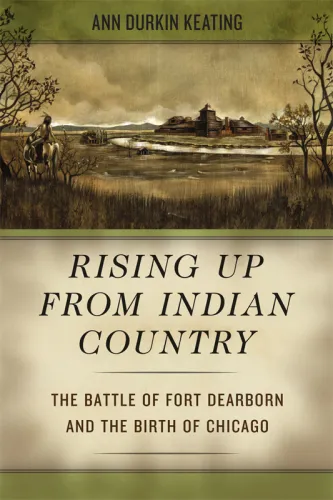
Rising Up from Indian Country: The Battle of Fort Dearborn and the Birth of Chicago
Kinzie, John;Keating, Ann Durkin
English
Intermediate
novel
4.4 / 5
0 reviews
2012
Published
xxiv, 294 pages : illustrations, maps ; 24 cm
pages
382
views
In August 1812, under threat from the Potawatomi, Captain Nathan Heald began the evacuation of ninety-four people from the isolated outpost of Fort Dearborn to Fort Wayne, hundreds of miles away. The group included several dozen soldiers, as well as nine women and eighteen childr
Before you read
What will you get from this book?
In August 1812, under threat from the Potawatomi, Captain Nathan Heald began the evacuation of ninety-four people from the isolated outpost of Fort Dearborn to Fort Wayne, hundreds of miles away. The group included several dozen soldiers, as well as nine women and eighteen children. After traveling only a mile and a half, they were attacked by five hundred Potawatomi warriors. In under an hour, fifty-two members of Heald's party were killed, and the rest were taken prisoner; the Potawatomi then burned Fort Dearborn before returning to their villages. These events are now seen as a foundational moment in Chicago's storied past. With Rising up from Indian Country, noted historian Ann Durkin Keating richly recounts the Battle of Fort Dearborn while situating it within the context of several wider histories that span the nearly four decades between the 1795 Treaty of Greenville, in which Native Americans gave up a square mile at the mouth of the Chicago River, and the 1833 Treaty of Chicago, in which the American government and the Potawatomi exchanged five million acres of land west of the Mississippi River for a tract of the same size in northeast Illinois and southeast Wisconsin.;John Kinzie timeline -- General timeline -- A mobile cast of characters -- Preface : John Kinzie's world -- Introduction : Chicago in the Indian country of the western Great Lakes -- Part 1: The United States and the Indian country of the western Great Lakes. John Kinzie and the traders in the Indian country of the western Great Lakes, 1763-1812 ; The Greenville Treaty and the American era, 1789-1800 -- Part 2: Fort Dearborn and Tippecanoe, 1803-1811. President Jefferson and the founding of Fort Dearborn, 1803-1804 ; Kinzie & Forsyth, at Chicago and Peoria, 1803-1812 ; President Jefferson, Main Poc, and the founding of Tippecanoe, 1808-1811 ; Battle of Tippecanoe, November 1811 -- Part 3: In the wake of the Battle of Tippecanoe, late spring 1812. Planning for war, spring 1812 ; John Kinzie's ambiguous loyalties and a forgotten murder, May-June 1812 ; The war begins, June-July 1812 ; The Potawatomi attack, August 15, 1812 -- Part 4: In the aftermath of August 15, 1812. John and Eleanor Kinzie's neighbors, August 1812 ; Captors and captives, fall 1812 ; A savage fall : 1812 in the west ; 1813 : shifting alliances -- Part 5: After the War of 1812. The end of Indian country in the neighborhood of Chicago, 1816-1829 ; Kinzie's retreat to Chicago, 1816-1828 ; The 1833 Treaty of Chicago ; Why it was not a massacre.
Ask this book
Your question is answered in the context of this title and author. Each answer uses 2 points.
Sign in to ask the book assistant.
Reader reviews
0 reviews, 4.4 average out of 5
No reviews yet
If you have read this book, help the next reader with your experience.
Write a review
Sign in to publish a review.
Reader questions and answers
Ask a focused question and learn from the community.
Sign in to ask or answer a question.
No questions yet
Be the first to ask a clear, useful question.
What to read next
Related references that continue this learning path.
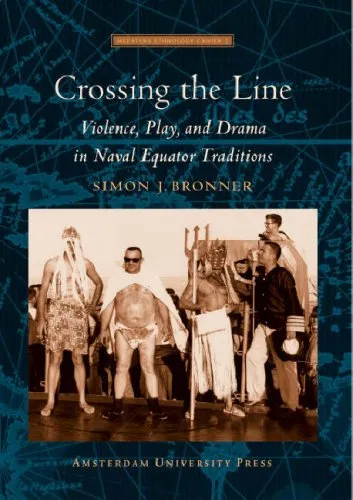
Crossing the Line: Violence, Play, and Drama in Naval Equator Traditions
Simon J. Bronner
2007
View book