

Book guide and evaluation
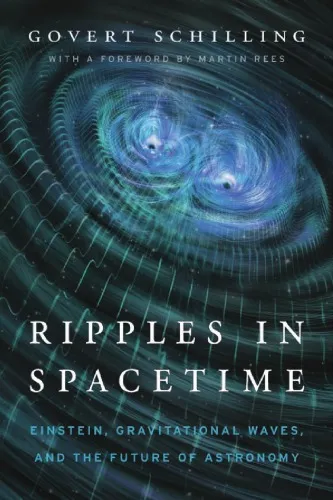
Ripples in spacetime: Einstein, gravitational waves, and the future of astronomy
Einstein, Albert;Schilling, Govert
English
Unordered
Unordered
4.6 / 5
0 reviews
2019
Published
353 / xi, 349 pages : illustrations ; 21 cm
pages
43
views
A spacetime appetizer -- Relatively speaking -- Einstein on trial -- Wave talk and bar fights -- The lives of stars -- Clockwork precision -- Laser quest -- The path to perfection -- Creation stories -- Cold case -- Gotcha -- Black magic -- Nanoscience -- Follow-up questions -- S
Before you read
What will you get from this book?
A spacetime appetizer -- Relatively speaking -- Einstein on trial -- Wave talk and bar fights -- The lives of stars -- Clockwork precision -- Laser quest -- The path to perfection -- Creation stories -- Cold case -- Gotcha -- Black magic -- Nanoscience -- Follow-up questions -- Space invaders -- Surf's up for Einstein wave astronomy.;It has already been called the scientific breakthrough of the century: the detection of gravitational waves. Einstein predicted these tiny ripples in the fabric of spacetime nearly a hundred years ago, but they were never perceived directly until now. Decades in the making, this momentous discovery has given scientists a new understanding of the cataclysmic events that shape the universe and a new confirmation of Einstein's theory of general relativity. Ripples in Spacetime is an engaging account of the international effort to complete Einstein's project, capture his elusive ripples, and launch an era of gravitational-wave astronomy that promises to explain,[...]more vividly than ever before, our universe's structure and origin. The quest for gravitational waves involved years of risky research and many personal and professional struggles that threatened to derail one of the world's largest scientific endeavors. Govert Schilling takes readers to sites where these stories unfolded--including Japan's KAGRA detector, Chile's Atacama Cosmology Telescope, the South Pole's BICEP detectors, and the United States' LIGO labs. He explains the seeming impossibility of developing technologies sensitive enough to detect waves from two colliding black holes in the very distant universe, and describes the astounding precision of the LIGO detectors. Along the way Schilling clarifies concepts such as general relativity, neutron stars, and the big bang using language that readers with little scientific background can grasp.--
Ask this book
Your question is answered in the context of this title and author. Each answer uses 2 points.
Sign in to ask the book assistant.
Reader reviews
0 reviews, 4.6 average out of 5
No reviews yet
If you have read this book, help the next reader with your experience.
Write a review
Sign in to publish a review.
Reader questions and answers
Ask a focused question and learn from the community.
Sign in to ask or answer a question.
No questions yet
Be the first to ask a clear, useful question.
What to read next
Related references that continue this learning path.



Biology of the Fungal Cell
Nicholas P. Money (auth.),Professor Dr. Richard J. Howard,Professor Dr. Neil A. R. Gow (eds.)
2001
View book