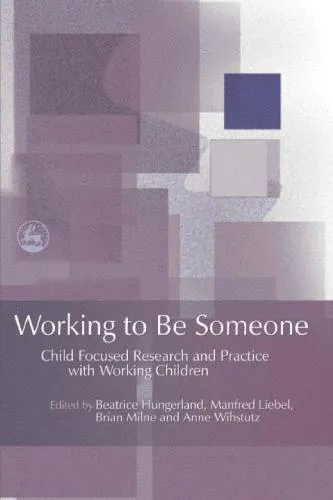
Working to be someone : child focused research and practice with working children
Beatrice Hungerland; et al
2007
View book
Book guide and evaluation
O’Connor, Morrie
0 reviews
Published
pages
views
Research and Practice in Intellectual and Developmental Disabilitiespp.178—181 intellectual and developmental disabilities research, evidence-based interventions An in-depth look at Research and Practice in Intellectual and Developmental Disabilitiespp.178—181 for scholars an
Before you read
The book section titled Research and Practice in Intellectual and Developmental Disabilitiespp.178—181 occupies a distinctive place within scholarly discourse on disability research. By concentrating on both rigorous academic inquiry and its practical implications, it bridges the essential gap between theory construction and the application of interventions in real-world contexts. Readers are guided through a dense yet navigable exploration of methods, case analyses, and conceptual frameworks that inform essential developments in the field.
Within these pages, the discussion synthesizes empirical findings with reflective commentary, offering insight into how research can actively inform and transform practice. Such a synthesis is especially important for those engaged in intellectual and developmental disabilities research, where the variability of individual needs requires nuanced approaches. The structure of the section ensures that complex statistical outcomes are interpreted with clarity, highlighting patterns and outliers while anchoring their relevance to day-to-day practices.
Although specific publication year details remain information unavailable due to no reliable public source, the thematic resonance of this section persists across academic cycles. The work reflects a multi-disciplinary orientation, drawing from psychology, education, social work, and public health domains to articulate a comprehensive understanding of applied disability research.
From these pages, readers will distill critical lessons about interplay between empirical evidence and actionable practice. The guidance offered is not only theoretical but directly relevant to professional contexts.
First, the section underscores the necessity of evidence-based interventions tailored to individual profiles within intellectual and developmental disabilities populations. Second, it addresses methodological rigor, urging practitioners to engage with research designs that are both ethically sound and pragmatically viable. Third, it stresses collaboration across professional boundaries, advocating for integrated service models. Fourth, readers are encouraged to view data as a tool for advocacy, translating quantitative outcomes into policy language. Finally, it prompts continual reflection, acknowledging that best practices are dynamic and evolve alongside emerging evidence.
Several statements within this segment of the book capture its enduring scholarly and practical value.
“Effective practice in intellectual and developmental disabilities emerges when robust evidence meets compassionate implementation.” Unknown
“Collaboration is not an optional addition to research—it is its lifeblood.” Unknown
“Data gains meaning when it drives change that dignifies human experience.” Unknown
Research and Practice in Intellectual and Developmental Disabilitiespp.178—181 matters because it navigates the intricate interplay between scholarly rigor and real-world applicability. Intellectual and developmental disabilities research can be fragmented if left within niche academic boundaries; this section advocates for dismantling those boundaries.
Its approach is valuable for both emerging scholars and seasoned professionals who grapple with translating research into everyday interventions. By offering a roadmap from data gathering through interpretation to applied action, it confronts the common disconnect between research output and service implementation. This is especially critical in environments where funding, policy, and public perception influence service delivery models.
Ultimately, the themes reinforced here contribute to a larger movement toward systemic change, ensuring institutions embed inclusivity and individualized care at the heart of their operational frameworks. Such systemic reorientation cannot occur without integrating the academic insight this section offers.
By the time readers complete Research and Practice in Intellectual and Developmental Disabilitiespp.178—181, they will have encountered a meticulous, humane, and forward-thinking investigation into the real power of applied research.
It offers more than mere academic enrichment; it builds a toolkit for tangible change in professional practice, informed by intellectual and developmental disabilities research and guided by principles that respect complexity and individuality. Readers are urged to take the next step: read deeply, discuss widely, and integrate these insights into their domains of influence. In doing so, they not only honor the spirit of this work but actively contribute to an ever-improving landscape of disability services and scholarship.
Your question is answered in the context of this title and author. Each answer uses 2 points.
0 reviews, 4.5 average out of 5
Sign in to publish a review.
Ask a focused question and learn from the community.
Related references that continue this learning path.
Beatrice Hungerland; et al