
Book guide and evaluation
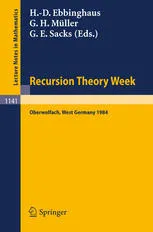
Recursion Theory Week: Proceedings of a Conference held in Oberwolfach, West Germany April 15–21, 1984
Klaus Ambos-Spies (auth.),Heinz-Dieter Ebbinghaus,Gert H. Müller,Gerald E. Sacks (eds.)
English
Intermediate
novel
4.0 / 5
0 reviews
1985
Published
426
pages
490
views
Introduction Welcome to the comprehensive exploration of 'Recursion Theory Week: Proceedings of a Conference held in Oberwolfach, West Germany April 15–21, 1984'. This book is an edited collection of papers and discussions presented during this pivotal conference, which br
Before you read
What will you get from this book?
Introduction
Welcome to the comprehensive exploration of 'Recursion Theory Week: Proceedings of a Conference held in Oberwolfach, West Germany April 15–21, 1984'. This book is an edited collection of papers and discussions presented during this pivotal conference, which brought together leading scholars and ambitious newcomers in the field of recursion theory. The wealth of knowledge encapsulated within these proceedings offers a remarkable insight into the development of recursion theory during the early 1980s, a period marked by significant theoretical advancements and innovative methodologies.
Detailed Summary
The 'Recursion Theory Week' book is a compilation of cutting-edge research and scholarly dialogue that took place over six days at a conference held in Oberwolfach, West Germany. This gathering was an intellectual assembly of bright minds focused on the study of recursion theory, a branch of mathematical logic that deals with the formalization of computable functions and Turing degrees.
The proceedings cover a diverse range of topics within recursion theory, including but not limited to complexity theory, algorithmic randomness, degrees of unsolvability, and Boolean algebras. Each paper within the book reflects the multi-faceted nature of recursion theory, presenting both theoretical frameworks and practical applications.
In addition to in-depth research papers, the book includes transcripts of pivotal discussions that provide readers with insights into the thought processes and collaborative efforts among researchers during the conference. These discussions also help illustrate the evolving nature of recursion theory and its influence on future research.
Key Takeaways
- The book highlights critical advancements in recursion theory during the early 1980s, showcasing how the field has evolved over time.
- It emphasizes the interdisciplinary nature of recursion theory, demonstrating its connections to other branches of mathematics and computer science.
- The proceedings offer a glimpse into the collaborative efforts in the field, illustrating how dialogue and debate influence scientific progress.
- Readers gain an understanding of the complexities involved in defining and analyzing computable functions and are invited to engage with ongoing challenges in the field.
Famous Quotes from the Book
"Recursion theory offers a foundation for understanding the limits of computability and the structure of algorithmic processes."
"The convergence of different methodologies in recursion theory often leads to unexpected breakthroughs and novel perspectives."
Why This Book Matters
The significance of 'Recursion Theory Week' lies in its role as a historical document and a rich resource for researchers, students, and professionals interested in recursion theory and related areas. This book captures a pivotal moment in the field's history, a time when foundational concepts were being challenged and expanded, setting the stage for future developments.
By compiling research and discussions from prominent figures in recursion theory, the book provides valuable insights into the collaborative nature of mathematical research and the importance of open dialogue in advancing knowledge. It serves as both a reference for those familiar with the field and a gateway for newcomers eager to understand the scope and impact of recursion theory in mathematics and computer science.
Overall, the proceedings from the 1984 conference in Oberwolfach encapsulate the vibrancy and dynamism of recursion theory, underscoring why it continues to be a thriving area of study with significant implications for computational theory and beyond.
Ask this book
Your question is answered in the context of this title and author. Each answer uses 2 points.
Sign in to ask the book assistant.
Reader reviews
0 reviews, 4.0 average out of 5
No reviews yet
If you have read this book, help the next reader with your experience.
Write a review
Sign in to publish a review.
Reader questions and answers
Ask a focused question and learn from the community.
Sign in to ask or answer a question.
No questions yet
Be the first to ask a clear, useful question.
What to read next
Related references that continue this learning path.


Introduction to Modern Traffic Flow Theory and Control: The Long Road to Three-Phase Traffic Theory
Boris S. Kerner (auth.)
2009
View book