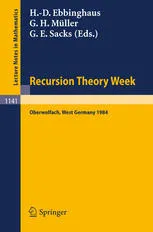
Recursion Theory Week: Proceedings of a Conference held in Oberwolfach, West Germany April 15–21, 1984
Klaus Ambos-Spies (auth.),Heinz-Dieter Ebbinghaus,Gert H. Müller,Gerald E. Sacks (eds.)
1985
View book
Book guide and evaluation
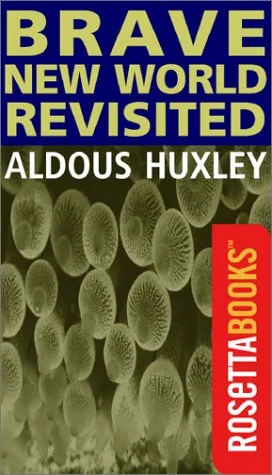
Aldous Huxley
0 reviews
Published
pages
views
Brave New World Revisited, penned by the acclaimed writer Aldous Huxley, is a profound commentary on the socio-political landscape of the mid-twentieth century and its uncanny resonance with the modern era. In this reflective examination, Huxley delves deeper into the world he
Before you read
Brave New World Revisited, penned by the acclaimed writer Aldous Huxley, is a profound commentary on the socio-political landscape of the mid-twentieth century and its uncanny resonance with the modern era. In this reflective examination, Huxley delves deeper into the world he originally crafted in his seminal work, Brave New World. Through a series of essays, he explores the potential realities and perils of a society that has succumbed to technological control, population pressure, and totalitarian regimes.
Brave New World Revisited is not a novel but a series of essays by Huxley exploring various topics such as overpopulation, over-organization, and psychological manipulation. The book serves as an analysis and critique of the disturbing trends foretold in Brave New World, arguing that many of its fictional themes had started manifesting in real life much sooner than anticipated.
Each chapter takes a critical look at a specific threat to individual freedom and societal stability in the contemporary world. Huxley warns of the dangers posed by excessive governmental control through propaganda and the stunning advancements in technology, which grant powerful tools to those who wish to manipulate the masses. These essays dig into topics like the increasing fragility of democratic institutions, the threat of overpopulation, and the manipulative potential of advertising and media.
Huxley’s introspective work strives to open the eyes of readers, urging them to question and, where possible, address these pressing issues before society irrevocably shifts towards an oppressive state akin to his envisioned dystopia.
Brave New World Revisited is brimming with insightful commentary, and several quotes stand out for their enduring relevance:
“The real hopeless victims of mental illness are to be found among those who appear to be most normal. Many of them are normal because they are so well adjusted to our mode of existence.”
“There are a great many people who belong in jail, but who are not there. There are a great many people who have never committed a crime, but who are in prison.”
The importance of Brave New World Revisited cannot be overstated. Huxley's critical evaluation stands as a stark reminder of the thin line between a world managed by technology for the betterment of humanity and one controlled to its detriment. The book’s insights into psychological manipulation, societal control, and the loss of individual freedoms offer a compelling reflection on today’s challenges.
With technological and political dynamics constantly evolving, the warnings and lessons from Huxley's essays are as pertinent as ever. Brave New World Revisited educates its readers on the potential futures we may face if current trajectories remain unaltered. Moreover, it urges an active engagement with societal issues, prompting individuals to be more discerning about the narratives and progressions within their environmental and political spheres.
In essence, this masterpiece serves not only as a cautionary tale but also as a call to action for safeguarding the principles of personal freedom and democracy—an endeavor that remains timelessly critical.
Your question is answered in the context of this title and author. Each answer uses 2 points.
0 reviews, 4.2 average out of 5
Sign in to publish a review.
Ask a focused question and learn from the community.
Related references that continue this learning path.
Klaus Ambos-Spies (auth.),Heinz-Dieter Ebbinghaus,Gert H. Müller,Gerald E. Sacks (eds.)