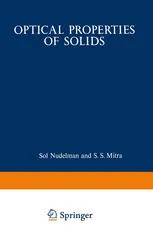
Optical Properties of Solids: Papers from the NATO Advanced Study Institute on Optical Properties of Solids Held August 7–20, 1966, at Freiburg, Germany
H. Jones (auth.),Sol Nudelman,S. S. Mitra (eds.)
1969
View book
Book guide and evaluation
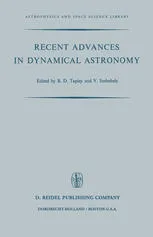
E. Stiefel (auth.),B. D. Tapley,V. Szebehely (eds.)
0 reviews
Published
pages
views
Introduction to "Recent Advances in Dynamical Astronomy" The book "Recent Advances in Dynamical Astronomy: Proceedings of the NATO Advanced Study Institute in Dynamical Astronomy Held in Cortina D’Ampezzo, Italy, August 9–21, 1972" serves as a cornerstone in the study of c
Before you read
The book "Recent Advances in Dynamical Astronomy: Proceedings of the NATO Advanced Study Institute in Dynamical Astronomy Held in Cortina D’Ampezzo, Italy, August 9–21, 1972" serves as a cornerstone in the study of celestial mechanics and astrophysical phenomena. Developed as part of a NATO Advanced Study Institute, the proceedings encapsulate some of the most groundbreaking insights and cutting-edge research in dynamical astronomy from a pivotal era in the early 1970s. This book offers an exceptional blend of theoretical and practical perspectives, aimed at enriching the understanding of how celestial bodies interact dynamically and evolving methodologies for predicting their behavior.
Edited by renowned experts B. D. Tapley and V. Szebehely, the volume brings together the collective expertise of leading scholars and researchers from around the world. The discussions, research findings, and debates presented in these proceedings stand as an indispensable resource for academics, researchers, and students of astronomical sciences. At its core, the book addresses issues ranging from the principles of celestial mechanics to the emerging computational techniques in dynamical astronomy during the early computer era. It reflects a period of significant advancement that still informs today's astronomical endeavors.
This book captures a wide array of topics within dynamical astronomy, providing a comprehensive understanding of key issues such as orbit determination, stability analysis in celestial systems, perturbation methods, and numerical integrations. Covering both theoretical foundations and computational advancements, the proceedings meticulously document lectures and discussions held over the course of the 1972 institute.
Primary topics of focus include:
This book is instrumental not only for students and educators in astronomy but also for researchers looking to apply dynamical theories to practical problems, such as satellite trajectory determination and interplanetary mission planning.
"The dynamical systems of the universe offer an endless tapestry of mathematical beauty and predictive power, reminding us of the intricate balances that govern celestial bodies."
"In the study of planetary motions, no single approach can suffice; it is the interplay of observation, computation, and theory that unveils the cosmos' secrets."
The relevance of "Recent Advances in Dynamical Astronomy" transcends the historical context in which it was written. Even decades later, the book continues to provide critical insights into topics that remain at the forefront of astrophysical research. Its content laid the groundwork for many advances in space exploration, such as accurate predictions of planetary motion, satellite orbit management, and the optimization of interplanetary transfer orbits.
Beyond its scientific value, the book exemplifies the importance of international collaboration in science. By bringing together scholars from across the globe to share their expertise, the proceedings highlight the collective effort required to unravel the complexities of the universe.
Today, as modern astronomers grapple with new challenges like exoplanet dynamics, asteroid tracking, and cosmic simulations on supercomputers, the foundational methodologies and principles outlined in this book continue to offer timeless guidance. For anyone passionate about astronomy, celestial mechanics, or the history of scientific progress, this book is a must-read and a testament to the enduring legacy of the 1972 NATO Advanced Study Institute.
Your question is answered in the context of this title and author. Each answer uses 2 points.
0 reviews, 4.0 average out of 5
Sign in to publish a review.
Ask a focused question and learn from the community.
Related references that continue this learning path.
H. Jones (auth.),Sol Nudelman,S. S. Mitra (eds.)
Daniel O. Odoh,Gbadebo M. Owolabi (auth.),Bo Song,Dan Casem,Jamie Kimberley (eds.)