Steel Odyssey: Tracing the Journey of Humanity Through the Lens of Steel
Ohjoon Kwon,Joo Choi,Hae-Geon Lee
2024
View book
Book guide and evaluation
Nicholas J. Cull,David Culbert,David Welch
0 reviews
Published
pages
views
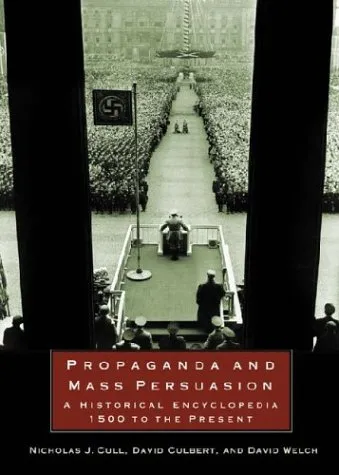
Propaganda and mass persuasion: a historical encyclopedia, 1500 to the present political communication, media influence Comprehensive reference on propaganda and mass persuasion: a historical encyclopedia, 1500 to the present, exploring global media influence. Analyt
Before you read
The book Propaganda and mass persuasion: a historical encyclopedia, 1500 to the present offers an expansive, meticulously researched chronicle of how propaganda and strategic mass communication have evolved over more than five centuries. Authored by Nicholas J. Cull, David Culbert, and David Welch, it provides an authoritative reference for educators, scholars, policy analysts, and media professionals seeking a deeper understanding of persuasive messaging in historical and modern contexts.
Drawing upon diverse sources and case studies, the encyclopedia unpacks the tools, techniques, and technologies that enabled political leaders, governments, and institutions to influence public opinion. It does not restrict its examination to wartime propaganda or political campaigns but extends its scope to cultural movements, social reform efforts, and commercial advertising. By situating examples within their political, social, and technological contexts, the authors illuminate the complex interplay between message creation, dissemination, and audience reception.
The analytical strength of this volume lies in its chronological breadth, from early printed pamphlets in the 1500s to the digital age’s multimedia messaging. It bridges historical scholarship with contemporary relevance, demonstrating that mass persuasion is neither a relic of the past nor a phenomenon limited to authoritarian regimes—it is an enduring element of human communication, shaped by evolving media channels and societal needs.
Readers will gain foundational and advanced insights from this encyclopedia, relevant to both academic inquiry and professional practice.
First, propaganda and mass persuasion are deeply embedded in social structures, capable of supporting both democratic engagement and manipulative control. Second, the development of mass media—from the printing press to broadcast television and social media—has consistently amplified the reach and impact of persuasive communications. Third, understanding historical precedents helps decode contemporary campaigns, offering predictive insights into future trends. Fourth, the book underscores the ethical dimensions of propaganda, presenting documented instances where messaging led to significant social consequences. Finally, it highlights the recurring patterns in persuasive strategies, enabling informed critique and responsible communication in any field.
“Propaganda is the deliberate, systematic attempt to shape perceptions, manipulate cognitions, and direct behavior.”Unknown
“Every age has its own forms of persuasion, molded by technology, culture, and politics.”Unknown
“To understand contemporary propaganda, one must first understand its history.”Unknown
This encyclopedia is not just a repository of facts; it is a critical tool for decoding the messages that permeate modern life.
In an age where digital communications blur the lines between information, persuasion, and manipulation, understanding the historical trajectory of propaganda equips readers to identify, analyze, and respond to persuasive messages with discernment. Its global scope ensures that lessons are not confined to any one nation or culture. By connecting past and present, the work empowers those in academia, governance, policy advocacy, journalism, and media production to apply historical insights to contemporary challenges.
Moreover, the balanced and scholarly presentation of complex subjects offers credible support for research projects, curriculum development, and informed public discourse. Even for non-specialists, the content is accessible enough to spark critical thinking about the narratives that shape society.
In closing, Propaganda and mass persuasion: a historical encyclopedia, 1500 to the present stands as an indispensable guide for anyone committed to understanding and engaging with the forces that shape human thought and societal direction.
Whether you are a scholar researching communication history, a professional navigating public relations, or a citizen striving to remain informed, this encyclopedia offers both breadth and depth of knowledge. Its exploration of political communication and media influence across centuries encourages critical engagement and responsible dissemination of information. We invite readers to immerse themselves in its pages, share its insights, and discuss its implications, advancing a collective awareness that is essential in today’s interconnected world.
Your question is answered in the context of this title and author. Each answer uses 2 points.
0 reviews, 4.3 average out of 5
Sign in to publish a review.
Ask a focused question and learn from the community.
Related references that continue this learning path.
Ohjoon Kwon,Joo Choi,Hae-Geon Lee

Muhammad Ibn Sa'd,Aisha Bewley