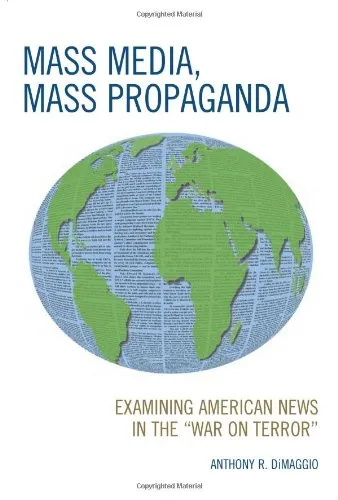
Mass Media, Mass Propaganda: Understanding the News in the 'War on Terror'
Anthony DiMaggio
2008
View book

Book guide and evaluation
Noam Chomsky
0 reviews
Published
pages
views
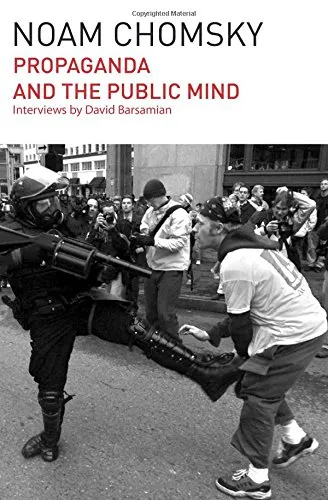
Propaganda and Control of the Public Mind media manipulation, political communication Explore Propaganda and Control of the Public Mind, a deep dive into how mass media shapes perception and public discourse. Analytical Summary *Propaganda and Control of the Publi
Before you read
*Propaganda and Control of the Public Mind* is an incisive exploration of the mechanisms through which political, economic, and media institutions influence collective thought. Written with a critical eye toward systemic power structures, the work presents a coherent framework for understanding how information is curated, distorted, and disseminated to sustain societal control.
This book situates propaganda not as blatant falsehood, but as a subtle, often invisible force that frames public consciousness. It examines historical and contemporary case studies, identifying recurring patterns by which narratives are constructed and dissent is marginalized. Through this lens, readers are encouraged to see beyond surface-level messaging and scrutinize the underlying intentions behind information flows.
The author insists that the study of propaganda is inseparable from understanding power itself, as control of the public mind is a prerequisite for political stability among ruling elites. The analysis draws from political theory, linguistics, sociology, and media studies to build a multidimensional account—making it essential reading for serious students of democracy and social change.
The following are the most salient insights from *Propaganda and Control of the Public Mind*, offering both scholars and practitioners a distillation of its arguments.
First, media manipulation operates most effectively when audiences believe they are receiving unfiltered truth. Understanding this paradox is crucial to identifying propaganda’s subtle forms.
Second, dominant narratives often rely on repetition and selective omission, shaping public perception without resorting to overt censorship.
Third, the intertwining of state power and corporate interests magnifies the asymmetry between those who produce information and those who consume it.
Fourth, critical literacy—an informed skepticism toward media messages—is a necessary defense against manipulation.
Finally, while the book’s focus is analytical, it implicitly calls for active citizenship to counterbalance these systemic forces.
“If we don't believe in freedom of expression for people we despise, we don't believe in it at all.”Unknown
“Propaganda is to democracy what the bludgeon is to a totalitarian state.”Unknown
“The smart way to keep people passive and obedient is to strictly limit the spectrum of acceptable opinion.”Unknown
In an era where information travels instantly across digital networks, understanding the principles explored in *Propaganda and Control of the Public Mind* is more urgent than ever.
The book offers a timeless framework for recognizing how narratives are shaped, whether through traditional broadcast channels or algorithmically curated feeds. As media manipulation and political communication evolve, the tools of analysis presented here remain uniquely potent.
Information about awards or year of publication is unavailable, as no reliable public source confirms such details. This transparency reflects the same critical approach urged within the text: distrust unsubstantiated claims and verify every piece of information.
*Propaganda and Control of the Public Mind* is not just a study, but a call to engagement. It confronts readers with the uncomfortable reality that the shaping of public opinion is an enduring feature of modern societies.
By absorbing its insights, readers position themselves to step beyond passive consumption and into informed critique. The text invites continuous dialogue—share it with colleagues, discuss it in seminars, and test its arguments against daily news and political events. In doing so, you embody the active, questioning citizen the book envisions, ensuring that controlling the public mind is met with equally resolute public awareness.
Your question is answered in the context of this title and author. Each answer uses 2 points.
0 reviews, 4.3 average out of 5
Sign in to publish a review.
Ask a focused question and learn from the community.
Related references that continue this learning path.
Anthony DiMaggio