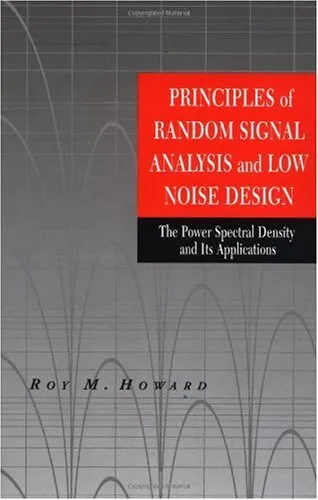
Book guide and evaluation
Principles of Random Signal Analysis and Low Noise Design: The Power Spectral Density and its Applications
Roy M. Howard
English
Beginner
Engineering
4.4 / 5
0 reviews
2002
Published
321
pages
462
views
Introduction to 'Principles of Random Signal Analysis and Low Noise Design: The Power Spectral Density and its Applications' Welcome to the extensive realm of signal analysis and low noise design, explored comprehensively in "Principles of Random Signal Analysis and Lo
Before you read
What will you get from this book?
Introduction to 'Principles of Random Signal Analysis and Low Noise Design: The Power Spectral Density and its Applications'
Welcome to the extensive realm of signal analysis and low noise design, explored comprehensively in "Principles of Random Signal Analysis and Low Noise Design: The Power Spectral Density and its Applications". This book serves as a definitive guide for professionals and students alike who are delving into the sophisticated world of random signal analysis, emphasizing the profound importance of the power spectral density (PSD).
Detailed Summary of the Book
This book lays down the foundational theories and practical applications of random signal analysis, aiming to bridge the gap between theory and real-world applications. It intricately discusses various mathematical models and the stochastic processes responsible for random signal behavior. The Power Spectral Density, as a central topic, is explored with precision, offering insights into its role in characterizing frequency content in random signals.
Throughout the book, readers encounter detailed discussions about statistical signal processing, linear system theory, noise analysis, and filtering techniques. By providing a practical framework and examples, it elucidates how these theoretical concepts find application in designing systems with minimal noise and interference. A clear comprehension of these principles allows for innovations in telecommunications, audio engineering, and other fields reliant on low noise systems.
Key Takeaways
- Comprehensive understanding of the fundamentals of random signal analysis.
- In-depth exploration of Power Spectral Density and its applications.
- Insight into the importance of noise reduction in electronic and communication systems.
- Practical approaches to applying theoretical concepts in real-world scenarios.
- Advanced techniques in statistical signal processing and filtering.
Famous Quotes from the Book
"The pursuit of diminishing noise is not just about clarity in communication, but the fidelity of the message itself."
"Understanding the dance of randomness in signals leads to mastering the art of predictability and control in design."
Why This Book Matters
The significance of this book stretches far beyond its pages, impacting industries that rely heavily on signal processing and noise management. For students and professionals in engineering disciplines, it serves as a vital educational tool that equips them to tackle challenges in designing high-performing, noise-resilient systems.
In the broader context of technology and engineering, understanding these principles is crucial for advancements that push the boundaries of what is possible. As technology becomes more sophisticated and integrated into every aspect of life, professionals equipped with the knowledge from this book will be at the forefront of innovation, capable of solving complex problems with ingenuity and precision.
Ask this book
Your question is answered in the context of this title and author. Each answer uses 2 points.
Sign in to ask the book assistant.
Reader reviews
0 reviews, 4.4 average out of 5
No reviews yet
If you have read this book, help the next reader with your experience.
Write a review
Sign in to publish a review.
Reader questions and answers
Ask a focused question and learn from the community.
Sign in to ask or answer a question.
No questions yet
Be the first to ask a clear, useful question.
What to read next
Related references that continue this learning path.
Engineering thermofluids: thermodynamics, fluid mechanics, and heat transfer
Mahmoud Massoud
2005
View book
Sparse Representations and Compressive Sensing for Imaging and Vision
Vishal M. Patel,Rama Chellappa
2013
View book