

Ideals, varieties, and algorithms: an introduction to computational algebraic geometry and commutative algebra
David A. Cox,John Little,Donal O’Shea
2007
View book
Book guide and evaluation
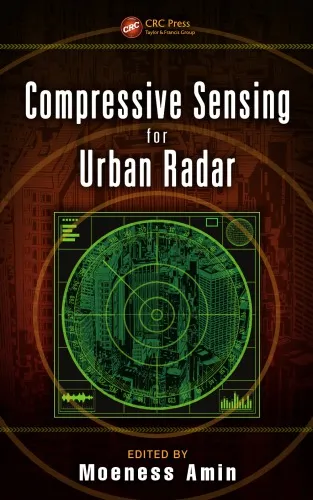
Moeness G Amin
0 reviews
Published
pages
views
Welcome to the intricate world of urban radar technology. As urban environments become increasingly congested, there is a critical need for advanced methodologies to efficiently process the vast amounts of data generated within these domains. In "Compressive Sensing for Urban
Before you read
Welcome to the intricate world of urban radar technology. As urban environments become increasingly congested, there is a critical need for advanced methodologies to efficiently process the vast amounts of data generated within these domains. In "Compressive Sensing for Urban Radar," we delve into the revolutionary field of compressive sensing and its applications to modern urban radar systems.
This book presents a comprehensive guide to the principles and applications of compressive sensing within urban radar systems. It aims to bridge the gap between traditional radar processing techniques and the emerging paradigm of sparse signal acquisition. Through its pages, readers are introduced to the fundamentals of radar technology and how compressive sensing offers a transformative approach to data acquisition and processing.
We explore the mathematical underpinnings of compressive sensing, explaining how it exploits signal sparsity to reconstruct high-fidelity data from seemingly incomplete measurements. This is especially pertinent in urban environments, where clutter and interference pose significant challenges to radar signal clarity and resolution.
The book also covers various algorithms and optimization techniques critical for implementing compressive sensing in a practical radar context. From greedy algorithms to more sophisticated frameworks, each method is discussed with an emphasis on its strengths and applicability to different urban scenarios.
Real-world case studies and examples are provided throughout the book, illustrating the effectiveness of compressive sensing in enhancing urban radar systems. These examples demonstrate the improved target detection, reduced data acquisition times, and enhanced robustness against noise and interference that compressive sensing methodologies offer.
"In the labyrinth of urbanity, compressive sensing lights the path to clarity."
"Sparse is powerful: The ability to reveal the underlying structure with less is the hallmark of compressive sensing."
As cities around the world grow larger and more complex, the demand for intelligent monitoring systems becomes paramount. Radars that can adapt to such dynamic environments are crucial for everything from traffic management to security and surveillance. "Compressive Sensing for Urban Radar" provides groundbreaking insights that equip researchers, engineers, and policymakers with the knowledge required to harness advanced radar capabilities.
The discussions within these pages foster deeper collaboration between academia and industry, inspiring innovations that will lead to safer, more efficient urban living spaces. This book not only answers the 'how' of applying compressive sensing in urban radar systems but also the 'why'—addressing the larger context and implications of these technologies in modern-day urban planning.
Your question is answered in the context of this title and author. Each answer uses 2 points.
0 reviews, 4.2 average out of 5
Sign in to publish a review.
Ask a focused question and learn from the community.
Related references that continue this learning path.
David A. Cox,John Little,Donal O’Shea

Michael T. Goodrich,Roberto Tamassia,Michael H. Goldwasser
Kent Lee,Steve Hubbard