

Sketching User Experiences: The Workbook
Saul Greenberg, Sheelagh Carpendale, Nicolai MarquardtandBill Buxton (Auth.)
2011
View book
Book guide and evaluation
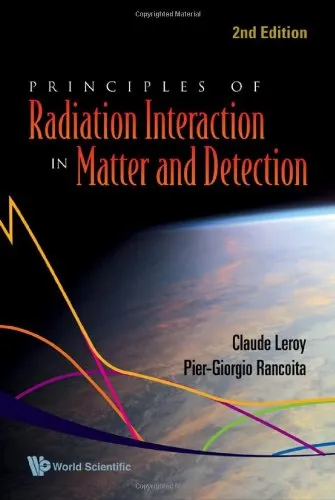
Claude Leroy,Pier-Giorgio Rancoita
0 reviews
Published
pages
views
Introduction to "Principles of Radiation Interaction in Matter and Detection" Written by Claude Leroy and Pier-Giorgio Rancoita, "Principles of Radiation Interaction in Matter and Detection" is a comprehensive guide exploring the fascinating domain of radiation physics and its
Before you read
Written by Claude Leroy and Pier-Giorgio Rancoita, "Principles of Radiation Interaction in Matter and Detection" is a comprehensive guide exploring the fascinating domain of radiation physics and its applications in particle detection. With its cutting-edge content, scientifically rigorous approach, and wide-ranging relevance, this book has become an invaluable resource for students, researchers, and professionals working in fields related to nuclear physics, medical imaging, and particle detector development.
Radiation interaction is a fundamental phenomenon governing many crucial processes in both natural and technological settings. From the precise mechanisms of energy deposition in matter to the implementation of state-of-the-art detection techniques, this book covers the crucial principles and applications of particle interaction with matter in a detailed and accessible manner. As the field continues to evolve due to advancements in science and technology, this work remains a pivotal reference to bridge the gap between theoretical understanding and real-world applications.
The book opens by providing a foundational understanding of the interaction of radiation with matter. Early chapters lay the groundwork by covering key concepts such as ionization, excitation, and scattering. These discussions are deeply rooted in both quantum mechanics and classical electrodynamics, offering readers a balanced perspective on the underlying principles.
The authors systematically build upon these foundations to discuss energy transfer mechanisms, with detailed explanations of stopping power, ranges of particles, and the Bethe-Bloch equation. Subsequent chapters expand into more advanced topics, such as nuclear interactions, electromagnetic cascades, and radiation dosimetry.
Central to the book is its comprehensive treatment of particle detection mechanisms. The authors meticulously describe different types of detectors, including gaseous detectors, scintillation detectors, semiconductor devices, and Cherenkov counters. Each section delves into the design principles, working mechanisms, and performance characteristics of these devices, making the book incredibly practical for professionals in instrumentation and experimental physics.
The book does not restrict itself to theory alone but includes an abundance of real-world examples, case studies, and problem sets. Whether discussing the role of radiation in medical imaging or analyzing its applications in high-energy physics experiments, the text ensures relevance to contemporary scientific challenges.
"The interaction of radiation with matter is not just a series of random events but a window into the structured and ordered nature of the universe."
"Detectors are the eyes of physics experiments; their precision and reliability dictate the clarity and veracity of the truths they unearth."
"Radiation interaction is not only a fundamental phenomenon in understanding our universe but also an indispensable tool for advancing technology and medicine."
"Principles of Radiation Interaction in Matter and Detection" is more than just a textbook; it is a cornerstone of modern scientific education and practice. In an era where interdisciplinary approaches dominate scientific endeavors, this book provides the essential bridge between physics, engineering, and applied sciences. Its detailed exploration of particle detection technologies equips researchers and professionals with the tools necessary to tackle pressing challenges in diverse fields, including nuclear energy, space exploration, and medical diagnostics.
Furthermore, the clarity and depth of this work make it an unparalleled resource for educators. By addressing both foundational concepts and advanced applications, it serves as a guide for structuring courses that can cater to both undergraduate students and postgraduate researchers. The inclusive scope of this book ensures its relevance not just to physicists, but also to professionals in industries where radiation plays a critical role.
Whether you are an aspiring researcher looking to understand the principles of radiation, or a professional aiming to design and implement innovative detection systems, this book stands as a definitive reference. It emphasizes not just the "how" but also the "why," making it a vital resource for anyone committed to unraveling the intricate interplay of radiation and matter.
Your question is answered in the context of this title and author. Each answer uses 2 points.
0 reviews, 4.5 average out of 5
Sign in to publish a review.
Ask a focused question and learn from the community.
Related references that continue this learning path.
Saul Greenberg, Sheelagh Carpendale, Nicolai MarquardtandBill Buxton (Auth.)
Harald Ibach,Hans Lüth (auth.)
![Cover of The Feynman Lectures on Physics [Vol 1]](https://s3.refhub.ir/images/thumb/The_Feynman_Lectures_on_Physics__Vol_1_15281.webp)