Book guide and evaluation
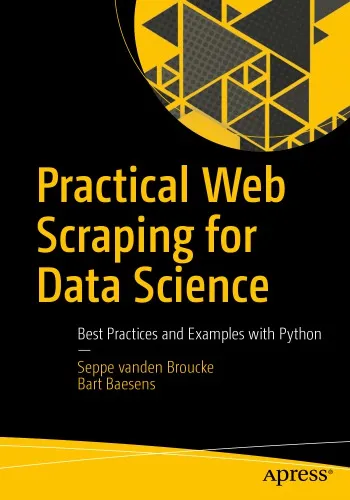
Practical Web Scraping for Data Science: Best Practices and Examples with Python
Broucke, Seppe vanden;Baesens, Bart
English
Unordered
Data Science
4.4 / 5
0 reviews
2018
Published
313
pages
244
views
Practical Web Scraping for Data Science: Best Practices and Examples with Python Web scraping techniques, Python data science applications Master data extraction with Practical Web Scraping for Data Science: Best Practices and Examples with Python for effective analysis
Before you read
What will you get from this book?
Analytical Summary
In the rapidly evolving field of data science, the ability to gather, clean, and analyze data from diverse online sources has become an indispensable skill. Practical Web Scraping for Data Science: Best Practices and Examples with Python is a resource designed to equip readers with actionable strategies to automate data acquisition through Python-based web scraping, while adhering to ethical and legal standards.
Written by Broucke, Seppe vanden and Baesens, Bart, the book takes an authoritative yet approachable stance, offering readers—from academics to industry professionals—a guiding hand in navigating the complexities of extracting valuable information from HTML pages, APIs, and dynamic web environments.
Through clear explanations and well-chosen examples, the work breaks down intricate technical procedures into digestible steps. It examines libraries such as Beautiful Soup, Requests, and Selenium, illustrating their advantages, limitations, and best-use scenarios in real-world projects.
Structured to progress from foundational concepts to more advanced techniques, the text ensures that both novice and seasoned Python practitioners can derive value. It is situated at the intersection of theoretical understanding and pragmatic execution, making it a noteworthy addition to the literature on web scraping techniques for data science.
Key Takeaways
Readers will find that the book merges the rigor of technically sound practices with the flexibility required to adapt to modern data acquisition challenges.
Key lessons include an in-depth exploration of Python’s leading scraping libraries, methods to handle structured and unstructured data, and protocols for respecting robots.txt directives.
Additionally, the work underscores the importance of cleaning and validating scraped data, emphasizing not just data quantity, but quality.
Ethical considerations are thoroughly addressed, with discussion of responsible scraping habits, consent, and transparency—critical factors for maintaining trust and compliance.
Finally, the inclusion of practical, reproducible examples allows readers to cement their knowledge through hands-on projects, encouraging experimentation and learning by doing.
Memorable Quotes
"Web scraping is not just about collecting data; it’s about collecting the right data the right way." Unknown
"Ethics in web scraping are as vital as the code itself." Unknown
"Python’s versatility turns data gathering into a refined, repeatable process." Unknown
Why This Book Matters
In academic research, industry analytics, and innovation, timely data is the currency of insight.
Practical Web Scraping for Data Science: Best Practices and Examples with Python offers a confluence of sound methodology and practical illustration, enabling readers to acquire data reliably and responsibly.
The book’s relevance spans disciplines—from market analysis and finance, to journalism and scientific research—demonstrating how web scraping serves as a bridge between the dynamic web and structured analysis-ready datasets.
Information on publication year or any accolades is unavailable due to no reliable public source for verification, yet its methodological solidity ensures its unchallenged place in professional toolkits.
Inspiring Conclusion
Armed with the insights and methodologies presented in Practical Web Scraping for Data Science: Best Practices and Examples with Python, readers are well-positioned to transform their data acquisition capabilities.
Whether you are seeking to enrich academic research, fuel business intelligence projects, or expand your skill set, this book makes web scraping accessible, ethical, and practical within the Python ecosystem.
The next step is clear: engage with the examples, share your progress, and discuss these approaches with peers to refine your own scraping practice. By doing so, you honor both the letter and spirit of responsible, insightful data science.
Ask this book
Your question is answered in the context of this title and author. Each answer uses 2 points.
Sign in to ask the book assistant.
Reader reviews
0 reviews, 4.4 average out of 5
No reviews yet
If you have read this book, help the next reader with your experience.
Write a review
Sign in to publish a review.
Reader questions and answers
Ask a focused question and learn from the community.
Sign in to ask or answer a question.
No questions yet
Be the first to ask a clear, useful question.
What to read next
Related references that continue this learning path.
Data Science: The Hard Parts: Techniques for Excelling at Data Science
Daniel Vaughan
2023
View book
Learning Data Science: Data Wrangling, Exploration, Visualization, and Modeling with Python
Sam Lau,Joseph Gonzalez,Deborah Nolan
2023
View book