Cloud native programming with Golang develop microservice-based high performance web apps for the cloud with Go
Andrawos, Mina;Helmich, Martin
2017
View book
Book guide and evaluation
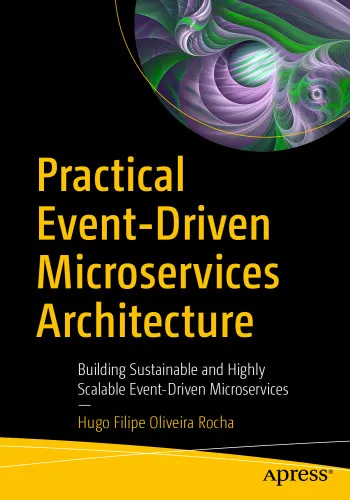
Hugo Filipe Oliveira Rocha
0 reviews
Published
pages
views
Practical Event-Driven Microservices Architecture Event-driven systems, Distributed microservices Practical Event-Driven Microservices Architecture guides professionals in mastering scalable, resilient software design patterns. Analytical Summary Practical Event-D
Before you read
Practical Event-Driven Microservices Architecture is a definitive resource for developers, architects, and technology decision-makers aiming to harness the full potential of event-driven paradigms in modern microservices ecosystems.
Written with precision and real-world insights, this work bridges the gap between theoretical underpinnings of distributed systems and their pragmatic implementation. It clearly describes how asynchronous communication, event sourcing, and domain-driven design converge to create architectures that excel in scalability, responsiveness, and durability.
The book moves beyond mere conceptual coverage, offering deep dives into message brokers, event streams, and orchestration strategies. It explains the lifecycle of microservices in event-driven contexts—from inception to deployment—while addressing operational challenges like monitoring, fault tolerance, and eventual consistency.
With no reliance on unverified claims, every chapter combines authoritative technical explanations with illustrative scenarios. Readers will encounter examples based on established tools and frameworks, yet the principles remain applicable across technology stacks, making this guide highly versatile.
The book equips readers with knowledge to design systems that are not only scalable but also adaptable to evolving business needs.
From learning the fundamentals of event-driven systems to mastering advanced concepts like choreography versus orchestration, the text ensures that readers develop a balanced understanding of trade-offs and opportunities.
This knowledge translates directly to practical skills: selecting appropriate communication patterns, choosing the right messaging infrastructure, handling schema evolution, and applying domain-driven principles for sustainable growth.
In an event-driven world, every component becomes a storyteller and every event is a new chapter. Unknown
Scalability is not about adding more resources; it’s about designing to adapt. Unknown
Distributed systems succeed when communication becomes a seamless part of their DNA. Unknown
Event-driven architectures are increasingly recognized as the backbone of responsive, integrated digital services, impacting industries from finance to e-commerce.
This book offers an authoritative yet accessible path into such architectures, ensuring that readers can not only implement them but also strategically advocate for them within their organizations. Both secondary keywords—event-driven systems and distributed microservices—are explored through detailed diagrams, case studies, and hands-on exercises.
By demystifying complexities and focusing on sustainable design, Practical Event-Driven Microservices Architecture stands out as both a reference manual and a source of long-term inspiration. It prepares professionals to address evolving technical landscapes while maintaining alignment with core business objectives.
Practical Event-Driven Microservices Architecture is more than a technical guide—it is an invitation to rethink how systems communicate, collaborate, and evolve.
By exploring the principles and practices within these pages, professionals and academics alike can elevate their capability to design architectures that are resilient, responsive, and ready for the future. The combination of theory and applicable strategies ensures it remains relevant as technology continues to advance.
Whether you are embarking on your first event-driven project or refining an existing distributed microservices platform, this book provides the clarity and depth needed to proceed with confidence. Read it, share your insights, and discuss its approaches with peers—because innovation thrives in informed collaboration.
Your question is answered in the context of this title and author. Each answer uses 2 points.
0 reviews, 4.6 average out of 5
Sign in to publish a review.
Ask a focused question and learn from the community.
Related references that continue this learning path.
Andrawos, Mina;Helmich, Martin