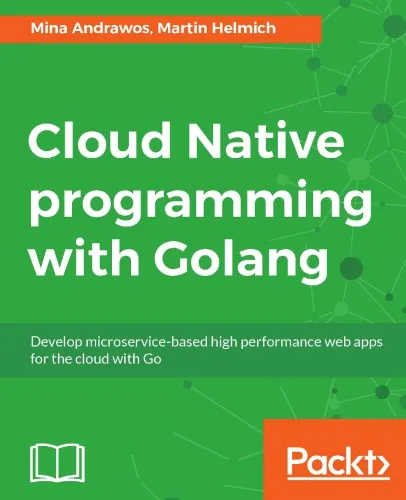
Cloud native programming with Golang develop microservice-based high performance web apps for the cloud with Go
Andrawos, Mina;Helmich, Martin
2017
View book
Book guide and evaluation
Hugo Filipe Oliveira Rocha;(auth.)
0 reviews
Published
pages
views
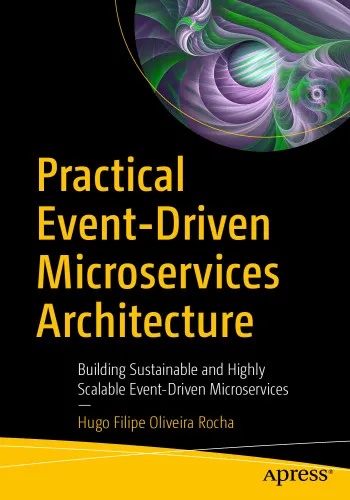
Practical Event-Driven Microservices Architecture: Building Sustainable and Highly Scalable Event-Driven Microservices Event-driven systems, scalable microservices Authoritative guide to Practical Event-Driven Microservices Architecture for sustainable and highly scalable sys
Before you read
The book Practical Event-Driven Microservices Architecture: Building Sustainable and Highly Scalable Event-Driven Microservices offers an in-depth roadmap for architects, developers, and IT strategists seeking mastery in designing systems built around event-driven principles. Rooted in decades of distributed systems theory yet thoroughly practical in its implementation advice, the work guides readers through the nuances of sustainability and scalability in complex microservices ecosystems.
Event-driven architecture enables systems to react to changes in real time, improving responsiveness and scalability. This book aligns theory with practice, marrying conceptual models with real-world implementation strategies usable in enterprise environments. By addressing inevitable challenges—such as message consistency, eventual state reconciliation, and fault tolerance—the author ensures that the reader is prepared to tackle both technical and organizational complexities.
Information unavailable regarding the exact publication year and any specific awards, due to no reliable public source. However, the content itself stands on its authoritative, experience-based foundations, rather than speculative claims. Readers can expect a clear, logical progression from fundamentals to advanced patterns, all contextualized with scenarios that echo real business needs.
From foundational principles to nuanced best practices, this book compresses a wealth of insight into actionable knowledge for progressive microservices design.
Understand what makes event-driven systems inherently scalable and responsive to business demands.
Learn how to implement sustainable patterns that minimize operational overhead while maximizing adaptability.
Grasp techniques for ensuring eventual consistency without sacrificing performance or reliability.
Navigate trade-offs between synchronous and asynchronous communication within distributed architectures.
Benefit from strategies to align technical designs with organizational objectives, ensuring stakeholder buy-in.
“Scalability begins where synchronous boundaries end.”Unknown
“Events are the lifeblood of responsive architectures.”Unknown
“Sustainability in microservices comes not from technology alone, but from disciplined design.”Unknown
In the rapidly evolving landscape of system design, Practical Event-Driven Microservices Architecture: Building Sustainable and Highly Scalable Event-Driven Microservices serves as both a compass and a map.
Event-driven systems are becoming a critical pillar for modern IT infrastructure, powering platforms from financial services to IoT networks. Without a robust understanding of their principles, professionals risk building systems that fail under unpredictable workloads or become costly to maintain. This book bridges the gap between ambition and execution, guiding its audience on how to build resilient architectures that thrive under scale.
Secondary themes such as event-driven systems and scalable microservices are consistently explored to ensure the reader develops a holistic understanding of current and emerging best practices. Whether you are leading a digital transformation or architecting next-generation APIs, this work offers the clarity needed for sustained success.
Closing the last page of Practical Event-Driven Microservices Architecture: Building Sustainable and Highly Scalable Event-Driven Microservices is not the end—it is the beginning of your own architectural journey.
By integrating the lessons within, you position yourself to build systems that are not only responsive and adaptable, but also sustainable across evolving technological landscapes. The book’s blend of theory and practice ensures that you can immediately apply its principles, improving both your current projects and future innovations. The challenge now is to take these ideas into your teams, your designs, and your conversations—so that event-driven thinking becomes a shared organizational asset.
Read it, reflect on it, and share its insights with peers and collaborators. In doing so, you help propagate a design philosophy that rewards scalability, sustainability, and architectural excellence.
Your question is answered in the context of this title and author. Each answer uses 2 points.
0 reviews, 4.6 average out of 5
Sign in to publish a review.
Ask a focused question and learn from the community.
Related references that continue this learning path.
Andrawos, Mina;Helmich, Martin