Foundations in Microeconomic Theory: A Volume in Honor of Hugo F. Sonnenschein
Matthew O. Jackson,Andrew McLennan
2008
View book
Book guide and evaluation
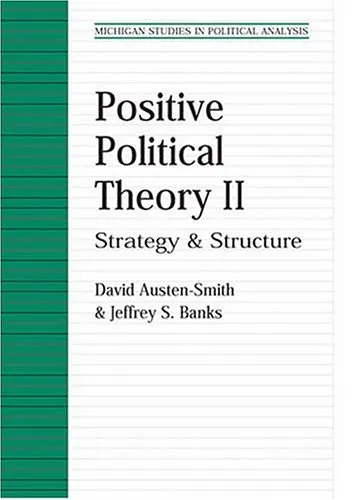
David Austen-Smith,Jeffrey S. Banks
0 reviews
Published
pages
views
Introduction to Positive Political Theory II: Strategy and Structure Welcome to an exploration of the intricate interplay between strategy and structure within political decision-making. "Positive Political Theory II: Strategy and Structure" offers a profound examination of po
Before you read
Welcome to an exploration of the intricate interplay between strategy and structure within political decision-making. "Positive Political Theory II: Strategy and Structure" offers a profound examination of political systems and behaviors, diving beyond the basic concepts to uncover the underlying mechanics of political decisions and strategies. The insights provided in this book are crucial for anyone interested in understanding how political actors formulate strategies and influence political outcomes within structured environments. Here, we present a detailed walkthrough of what to expect in this illuminating work.
The book is a comprehensive continuation of its predecessor, delving deeper into the realms of positive political theory. It intricately combines mathematical rigor with theoretical insights to model political strategy and structural interaction. Positive Political Theory II brings clarity to complex political processes by analytically dissecting how political actors within institutions design and execute strategies to achieve their goals. The authors emphasize models that have empirical implications, providing readers with tools to extend their understanding of real-world political phenomena. Utilizing game theory and decision theory, the work navigates through various strategic scenarios, examining how different institutional structures impact political behavior and outcomes.
The text is structured to first introduce key concepts and then progressively build complexity through theoretical models and applications in real-world contexts. By laying this groundwork, the authors enable readers to witness how foundational theories evolve into sophisticated strategies in structured political environments. Topics such as strategic voting, agenda control, coalition formation, and the effect of institutional rules on political competition, are explored in-depth.
"In the realm of political strategy, the rules of the game are often just as important as the players themselves."
"Understanding the constraints of institutional frameworks allows us to predict the course of political strategy with greater precision."
In the current era of complex political dynamics and ever-evolving institutional landscapes, "Positive Political Theory II: Strategy and Structure" stands out as a pivotal resource for scholars, policymakers, and students alike. This book not only provides theoretical grounding but also practical perspectives on navigating and influencing political structures. The incorporation of rigorous analytical methods equips readers to critically assess policy proposals, campaign strategies, and legislative processes. By marrying theory with practice, this book empowers its readers to engage more effectively in political discourse and strategy, offering them a clear lens through which to view the intricacies of political competition and cooperation in structured settings.
For those eager to refine their analytical skills and gain insight into the strategic mechanisms of political systems, this book delivers a wealth of knowledge. It is an essential read for anyone aiming to acquire a deeper comprehension of political theory and the strategic art underlying political structures.
Your question is answered in the context of this title and author. Each answer uses 2 points.
0 reviews, 4.9 average out of 5
Sign in to publish a review.
Ask a focused question and learn from the community.
Related references that continue this learning path.
Matthew O. Jackson,Andrew McLennan
Leon A. Petrosyan,Vladimir V. Mazalov,Nikolay A. Zenkevich