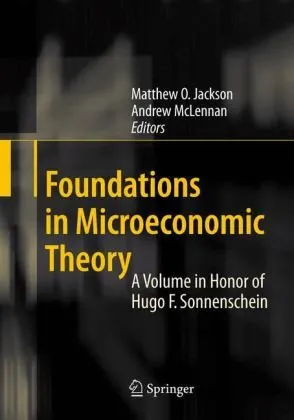
Foundations in Microeconomic Theory: A Volume in Honor of Hugo F. Sonnenschein
Matthew O. Jackson,Andrew McLennan
2008
View book
Book guide and evaluation
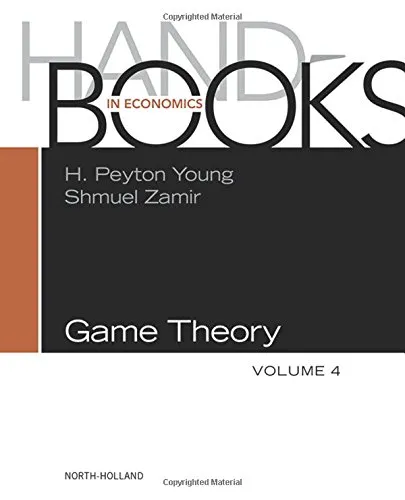
Petyon Young,Shmuel Zamir (eds.)
0 reviews
Published
pages
views
Introduction to the Handbook of Game Theory with Economic Applications, Vol.4 The "Handbook of Game Theory with Economic Applications, Vol.4" offers an extensive exploration of the intricate relationship between game theory and its application in economics. As the latest i
Before you read
The "Handbook of Game Theory with Economic Applications, Vol.4" offers an extensive exploration of the intricate relationship between game theory and its application in economics. As the latest installment in a distinguished series, this volume is a treasure trove of insights, incorporating the latest advancements in game theory and expanding on earlier volumes. Edited by renowned experts Peyton Young and Shmuel Zamir, this book stands as a comprehensive reference for academicians, researchers, and practitioners alike who seek to understand the strategic interactions underpinning economic models.
This volume delves into several innovative aspects of game theory, addressing both foundational theories and modern developments. The book is structured to provide an in-depth understanding of core concepts, beginning with classical game theory and extending into complex applications. It covers cooperative and non-cooperative games, auction theory, and the role of information in strategic decision-making.
New to this edition are discussions on evolutionary game theory, network games, and dynamic games, reflecting the evolving landscape of economic strategies. The editors have made a concerted effort to balance theoretical discussions with real-world applications, making this volume an invaluable resource for those seeking to draw connections between theory and practice.
"The beauty of game theory lies in its ability to transform seemingly complex interactions into quantifiable models."
"Every strategic decision is a game of anticipation, a chessboard where the moves are planned not just by one player, but by many."
"Handbook of Game Theory with Economic Applications, Vol.4" is more than just a compilation of theoretical constructs—it is a bridge between abstract theory and tangible economic phenomena. The editors, with their profound expertise, ensure that each contribution pushes the boundaries of conventional economics by introducing game-theoretical perspectives.
In a world where strategic interaction is central to societal challenges, from market competition to negotiation, this book equips readers with the tools necessary to navigate and understand these complex interactions. It is an essential read for anyone looking to deepen their understanding of how strategic considerations shape economic outcomes.
Your question is answered in the context of this title and author. Each answer uses 2 points.
0 reviews, 4.8 average out of 5
Sign in to publish a review.
Ask a focused question and learn from the community.
Related references that continue this learning path.
Matthew O. Jackson,Andrew McLennan
Leon A. Petrosyan,Vladimir V. Mazalov,Nikolay A. Zenkevich