Book guide and evaluation
Polity, Cambridge
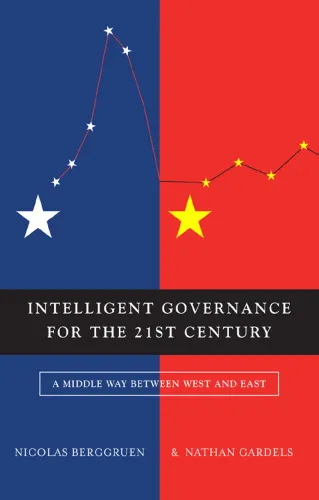
Nicolas Berggruen, Nathan Gardels
English
Unordered
Politics
4.3 / 5
0 reviews
2012
Published
209
pages
175
views
Polity, Cambridge Global governance, democratic transformation Polity, Cambridge offers a penetrating exploration of governance and democracy in a rapidly shifting global order. Analytical Summary The book Polity, Cambridge stands as a substantive intellectual end
Before you read
What will you get from this book?
Analytical Summary
The book Polity, Cambridge stands as a substantive intellectual endeavor, bridging rigorous political analysis with real-world applicability. Co-authored by Nicolas Berggruen and Nathan Gardels, it delves into the evolving structures of governance and the pressing necessity of adapting democratic institutions to the realities of an interconnected, multipolar world. With a keen eye for complexity, the authors examine the tension between national sovereignty and global interdependence, offering frameworks to reconcile the two.
Driven by empirical observation and philosophical depth, Polity, Cambridge articulates the challenges and opportunities arising in an era defined by technological acceleration, shifting geopolitical power, and environmental urgency. While rooted in political theory, it never loses sight of practical governance, blending insights from policy-making, economic systems, and cultural evolution. Notably, it refrains from prescriptive dogma, instead offering readers a structured approach to interpret and engage with the dynamics shaping the future.
The authors bring forward nuanced discussions on the role of civic engagement, the balance between efficiency and accountability, and the need for institutional reforms that are both innovative and inclusive. These points underscore the thesis that the health of democracy depends not merely on adherence to tradition but on its capacity for adaptation without losing legitimacy.
Key Takeaways
From its intricate analysis, Polity, Cambridge distills several core lessons that are valuable for policymakers, academics, and engaged citizens alike.
One key learning is that governance must transcend the boundaries of the nation-state to address global challenges — such as climate change or digital security — that do not respect geographic borders. Another is the importance of maintaining social cohesion amid diversity, requiring both cultural sensitivity and legal clarity. The text also emphasizes that reforms are most successful when they emerge from dialogue among stakeholders, rather than being imposed top-down.
Finally, the book reminds readers that the legitimacy of political institutions is built on responsiveness to the needs of the people and the foresight to anticipate future challenges — a point strikingly relevant in our age of volatility.
Memorable Quotes
“Democracy must evolve not in spite of complexity, but because of it.”Unknown
“Polity is about balancing the sovereignty of nations with the sovereignty of humanity.”Unknown
“Innovation without legitimacy is as fragile as tradition without renewal.”Unknown
Why This Book Matters
Polity, Cambridge is not just another academic exercise; it is an essential text for understanding the trajectory of governance in the 21st century.
Its relevance lies in its ability to speak to the precise crossroads at which global society finds itself. In bridging the conceptual divide between theory and practice, it offers actionable insights for leaders in government, civil society, and the private sector. In turn, it encourages readers to see themselves as active participants in shaping the polity rather than passive observers of political events.
For scholars, it provides a synthesizing lens that connects disparate disciplines — political science, economics, sociology — into a coherent narrative. For professionals in policy-making, it offers pragmatic frameworks that respect both local contexts and the broader global order. The book's discussions about democratic transformation remain pertinent in light of shifts such as populism, international migration, and technological disruption.
Inspiring Conclusion
In reading Polity, Cambridge, one gains not just knowledge but the impetus to participate in the evolution of governance itself.
The themes explored within these pages remind us that democracy and governance are not static achievements but ongoing processes requiring vigilance, creativity, and inclusivity. Whether you are an academic analyzing theoretical constructs or a practitioner crafting policy, this book offers tools to challenge assumptions and inspire constructive action.
Now is the moment to engage: read Polity, Cambridge, reflect on its insights, share them in your circles, and foster informed dialogue. In doing so, you become part of a broader, vital conversation shaping how our global polity will meet the demands of tomorrow.
Ask this book
Your question is answered in the context of this title and author. Each answer uses 2 points.
Sign in to ask the book assistant.
Reader reviews
0 reviews, 4.3 average out of 5
No reviews yet
If you have read this book, help the next reader with your experience.
Write a review
Sign in to publish a review.
Reader questions and answers
Ask a focused question and learn from the community.
Sign in to ask or answer a question.
No questions yet
Be the first to ask a clear, useful question.
What to read next
Related references that continue this learning path.
The Unheavenly Chorus: Unequal Political Voice and the Broken Promise of American Democracy
Kay Lehman Schlozman,Sidney Verba,Henry E. Brady
2012
View book