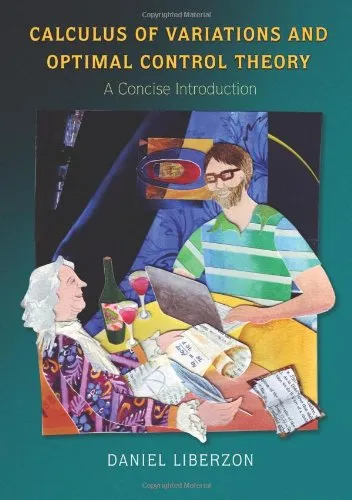
Calculus of Variations and Optimal Control Theory: A Concise Introduction
Daniel Liberzon
2012
View book
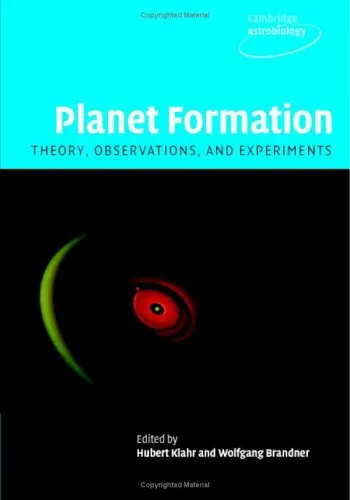
Book guide and evaluation
Wolfgang Brandner
0 reviews
Published
pages
views
Introduction to "Planet Formation: Theory, Observations, and Experiments" Planet formation has fascinated humanity for centuries, and our understanding of it continues to evolve through scientific inquiry and technological advancements. "Planet Formation: Theory, Observati
Before you read
Planet formation has fascinated humanity for centuries, and our understanding of it continues to evolve through scientific inquiry and technological advancements. "Planet Formation: Theory, Observations, and Experiments" is a comprehensive guide that brings together cutting-edge research, theoretical models, observational breakthroughs, and experimental insights into one volume. Written for researchers, educators, students, and science enthusiasts, this book bridges complex theories and practical understanding to explore the processes that govern how planets form and evolve. As part of the renowned Cambridge Astrobiology series, the book provides a wealth of knowledge to help readers appreciate the dynamics of planetary systems in the context of astrobiology.
The formation of planets is one of the most exciting and challenging areas in astrophysics. This book offers a detailed narrative on the lifecycle of planets, from the dense molecular clouds that give rise to stars to the dynamic processes within protoplanetary disks leading to planetary systems. The authors comprehensively discuss the role of gravitational collapse, accretion mechanisms, and disk turbulence in setting the stage for planet formation.
The book features three overarching pillars: theory, observations, and experiments. By addressing these areas holistically, it provides readers with a three-dimensional understanding of planet formation. Theoretical chapters delve into mathematical models, simulations, and equations that explain phenomena such as dust coagulation, core accretion, and orbital migration. Observational chapters highlight data collected from telescopes—both ground-based and space-based—and provide insight into newly discovered exoplanets, their atmospheres, and their host stars. The section on experiments gives readers a fascinating look at laboratory simulations that aim to replicate the physics of dust grains, gas, and plasma in controlled conditions.
In addition, the book touches on key interdisciplinary topics such as the habitability of planets, the emergence of water-rich worlds, and the possibility of life in exoplanetary systems. By combining rich visuals, accessible explanations, and cutting-edge research, this volume is a vital resource for understanding the phenomenon of planet formation within the broader context of the universe's evolution.
“Planet formation is not merely an astrophysical phenomenon; it is a story of chemistry, physics, and the universal dance of matter and motion.”
“By decoding the intricacies of planet formation, we also gain a profound understanding of the delicate balance that fosters habitability in the cosmos.”
The study of planet formation is central to unraveling some of humanity's deepest questions: How did the Solar System come to be? Are we alone in the universe? What factors make a planet suitable for life? This book matters because it offers an in-depth exploration of these pressing questions while being accessible to a wide audience.
For scientists, the book provides a rich repository of data, models, and experimental techniques that advance the frontier of planetary science. For educators and students, it serves as an indispensable resource for understanding foundational principles and applying them in research contexts. Moreover, for anyone captivated by the ongoing exploration of exoplanets and the quest for extraterrestrial life, this book supplies the scientific backbone needed to appreciate the profound implications of planet formation on a cosmic scale.
In our era of rapid technological advancements—where missions such as the James Webb Space Telescope and ambitious planetary explorations unlock vast new realms of data—"Planet Formation: Theory, Observations, and Experiments" is a timeless guide that helps readers navigate the intricate and awe-inspiring science of planetary genesis.
Your question is answered in the context of this title and author. Each answer uses 2 points.
0 reviews, 4.5 average out of 5
Sign in to publish a review.
Ask a focused question and learn from the community.
Related references that continue this learning path.
Daniel Liberzon

William Feller