
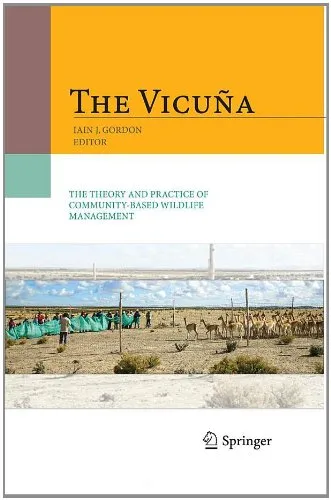
The Vicuna: The Theory and Practice of Community Based Wildlife Management
Iain Gordon (auth.),Iain J. Gordon (eds.)
2009
View book
Book guide and evaluation
Pivello, Vânia Regina; Vieira, Marcus Vinicius; Grombone-Guaratini, Maria Tereza; Matos, Dalva Maria Silva
0 reviews
Published
pages
views
Perspectives in Ecology and Conservationpp.74—82 Ecological theory, biodiversity management Explore Perspectives in Ecology and Conservationpp.74—82 with deep insights into ecological theory and biodiversity management. Analytical Summary The section titled Perspectives in
Before you read
The section titled Perspectives in Ecology and Conservationpp.74—82 represents a critical segment of scholarly work authored by Pivello, Vânia Regina; Vieira, Marcus Vinicius; Grombone-Guaratini, Maria Tereza; and Matos, Dalva Maria Silva. It captures nuanced discussions and analytical frameworks that underpin modern ecological research and practical conservation strategies. Designed for academics, environmental professionals, and advanced students, this work provides a structured examination of theories and case applications that bridge scientific knowledge with actionable efforts in biodiversity preservation.
Within pages 74 to 82, readers encounter a synthesis of ecological theory, field research interpretations, and management approaches targeted at sustaining ecological balance amid human pressures and climate dynamics. While specific publication year details remain “Information unavailable” due to lack of reliable sources, the intellectual merit of this section lies in its precise methodology and interdisciplinary perspective.
The authors employ a combination of qualitative and quantitative analyses to illustrate how different ecosystems respond to interventions. They also weigh the importance of adaptive management – a process where decision-making evolves alongside monitored environmental changes – a method particularly valuable in biodiversity management. This interplay between theory and practice situates the book as a vital resource in the ongoing dialogue about resilience and sustainability in ecology.
From this segment, several core insights emerge that resonate with professionals in conservation science and policy-making.
First, ecological theory is not merely an academic construct but a guiding framework for practical biodiversity management. Understanding species interactions, habitat requirements, and environmental thresholds enhances the precision of conservation interventions.
Second, the text emphasizes the necessity of integrating socio-economic contexts into ecological planning, recognizing that human communities are integral parts of ecosystems rather than external forces. This perspective helps ensure sustainable and culturally appropriate conservation outcomes.
Third, adaptive management emerges as a central theme, advocating for monitoring systems that inform iterative improvements in conservation efforts.
Finally, collaboration across disciplines — from botany to sociology — is framed as essential for addressing the multifaceted challenges of biodiversity loss.
"Conservation is not a static task but a dynamic process woven into the fabric of ecological change." Unknown
"Adaptive management thrives on real-world feedback, where learning shapes the path to sustainability." Unknown
"Biodiversity management is as much about people as it is about species." Unknown
The significance of Perspectives in Ecology and Conservationpp.74—82 lies in its balanced treatment of scientific rigor and applicability.
For academia, the section distills complex ecological models into digestible frameworks suitable for teaching and further research. For practitioners, it offers evidence-backed approaches to biodiversity management grounded in real-world contexts.
In the broader discourse, this work elevates ecological theory by embedding it within socio-ecological realities, reinforcing the idea that successful conservation demands inclusivity, adaptability, and constant learning.
Engaging with Perspectives in Ecology and Conservationpp.74—82 means entering a world where ecological theory and biodiversity management converge to inform actionable, sustainable practices.
By thoughtfully unpacking the contents of this segment, readers gain not only academic enrichment but also pragmatic tools to effect positive change in conservation landscapes. Whether you are a scholar, policymaker, or field practitioner, the insights presented here invite proactive dialogue and collaboration.
We encourage you to delve deeper into this critical work, share its insights with colleagues, and discuss its relevance in your professional circles. Let the ideas housed within Perspectives in Ecology and Conservationpp.74—82 inspire informed action toward maintaining the delicate balance of our planet's ecosystems.
Your question is answered in the context of this title and author. Each answer uses 2 points.
0 reviews, 4.5 average out of 5
Sign in to publish a review.
Ask a focused question and learn from the community.
Related references that continue this learning path.
Iain Gordon (auth.),Iain J. Gordon (eds.)

James S. Chisholm