Media and the Make-Believe Worlds of Children: When Harry Potter Meets Pokemon in Disneyland
Maya Gotz,Dafna Lemish,Amy Aidman,Hyesung Moon
2005
View book
Book guide and evaluation
Shahid Amin,Marcel van der Linden
0 reviews
Published
pages
views
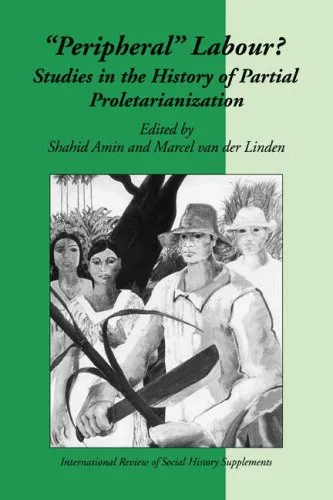
Peripheral Labour: Studies in the History of Partial Proletarianization offers a nuanced perspective on the complex dynamics of labor and capital in the developing world. Written by Shahid Amin and Marcel van der Linden, this book is a profound exploration of how part
Before you read
Peripheral Labour: Studies in the History of Partial Proletarianization offers a nuanced perspective on the complex dynamics of labor and capital in the developing world. Written by Shahid Amin and Marcel van der Linden, this book is a profound exploration of how partial proletarianization has historically unfolded across different regions. Featuring a collection of essays grounded in economic, cultural, and political analysis, this work provides fascinating insights into the interplay between labor systems and societal structures.
The book examines the concept of partial proletarianization, a process through which individuals and communities engage in wage labor intermittently while maintaining other forms of traditional labor or subsistence activities. It is a crucial scholarly resource for understanding how labor is increasingly precarious and multidimensional in today’s global economy. The book is structured into essays, each of which offers case studies from various regions, including Asia, Africa, and Latin America. These essays illuminate the historical contexts and economic conditions that give rise to partial proletarianization, providing readers with a comprehensive understanding of how labor markets are formed and transformed.
By dissecting the notion of "peripherality" in global economic systems, the authors argue that partial proletarianization is not merely a byproduct of underdevelopment but rather a fundamental characteristic of capitalist development at its margins. The essays contribute to a broader discourse on the ways in which economic and cultural factors have shaped labor relations, challenging dominant narratives that often neglect peripheral regions.
"Understanding the history of labor at the margins allows us to reframe the core assumptions of economic development and modernization."
"Partial proletarianization is not an aberration but a manifestation of the broader capitalist system, interacting uniquely with local conditions."
'Peripheral Labour' is a crucial text for historians, economists, and social scientists interested in the global complexities of labor markets. Its analytical depth and regional focus offer invaluable insights into how economic systems work beyond core capitalist countries. The book refutes simplified conceptions of labor development, instead presenting a world where diverse economic activities coexist and interact with wage labor. This scholarly work contributes significantly to the discourse on economic globalization, encouraging a rethinking of the pathways taken by different societies within the global economy. By focusing on "peripheral" regions, this book challenges readers to reconsider what is assumed to be the norm in economic development.
Your question is answered in the context of this title and author. Each answer uses 2 points.
0 reviews, 4.3 average out of 5
Sign in to publish a review.
Ask a focused question and learn from the community.
Related references that continue this learning path.
Maya Gotz,Dafna Lemish,Amy Aidman,Hyesung Moon