

Media and the Make-Believe Worlds of Children: When Harry Potter Meets Pokemon in Disneyland
Maya Gotz,Dafna Lemish,Amy Aidman,Hyesung Moon
2005
View book
Book guide and evaluation
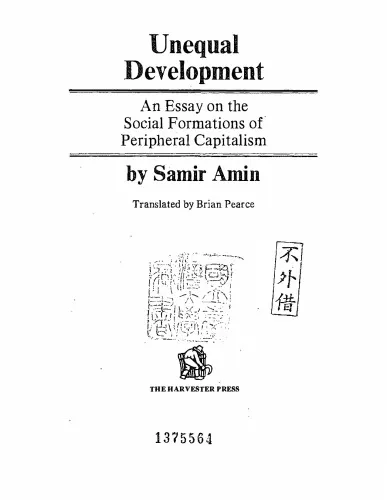
Samir Amin
0 reviews
Published
pages
views
Introduction to 'Unequal Development: An Essay on the Social Formations of Peripheral Capitalism' "Unequal Development: An Essay on the Social Formations of Peripheral Capitalism" is a seminal work by Samir Amin that delves into the complexities of global econo
Before you read
"Unequal Development: An Essay on the Social Formations of Peripheral Capitalism" is a seminal work by Samir Amin that delves into the complexities of global economic disparities. As a centerpiece of dependency theory, this book explores the intrinsic mechanisms of capitalism that perpetuate inequality between central and peripheral nations. By examining both historical and contemporary contexts, Amin provides a comprehensive analysis of how economic and social structures contribute to uneven development across the globe.
The essence of "Unequal Development" lies in its critical exploration of how capitalist systems inherently lead to disparities between what Amin terms as "center" and "peripheral" countries. The center countries, primarily the developed nations, are depicted as leveraging their economic and political power to maintain dominance over the peripheral nations, often former colonies or less developed countries.
Amin argues that development in capitalist societies is not homogenous or equitable. Rather, it is skewed by structures that promote the enrichment of the center at the expense of the periphery. He delves into the historical roots of these imbalances, tracing them back to colonial exploitation and the imposition of capitalist economic models that favor the center. Through the lens of political economy, Amin dismantles the myth of harmonious global development, showing instead that the system is rigged to preserve and perpetuate inequalities.
In his analysis, Amin highlights how trade imbalances, exploitative labor practices, and unequal capital flows all serve to widen the gap between rich and poor nations. He also explores the social formations that arise from these economic conditions, including the alteration of class structures within peripheral nations as a direct consequence of external economic pressures.
The concept of "peripheral capitalism" is critical to understanding global inequality, where peripheral countries remain subservient to central powers.
Historical context, such as colonialism, plays a crucial role in shaping current economic disparities.
Capitalism inherently generates unequal development, with the benefit of wealth accrual largely accruing to developed nations.
Structural reforms, rather than superficial aid, are necessary for truly equitable development.
"Development is a structured, unequal, and imbalanced process where some regions exploit others."
"The fantasy of a world market is dangerous because it ignores the power dynamics embedded within."
Samir Amin's "Unequal Development" is not merely an academic treatise; it is a call to acknowledge and address the persistent inequalities enforced by global capitalism. The book provides a critical framework for policy-makers, scholars, and activists to understand and challenge the mechanisms that perpetuate underdevelopment. Its insights into the structural facets of global capitalism remain relevant to current debates on inequality, globalization, and economic justice.
In the wake of increasing globalization and its associated challenges, "Unequal Development" offers a crucial perspective on why some nations thrive while others struggle. Amin's incisive critique empowers readers to question accepted economic narratives and seek more equitable pathways to global development.
Your question is answered in the context of this title and author. Each answer uses 2 points.
0 reviews, 4.5 average out of 5
Sign in to publish a review.
Ask a focused question and learn from the community.
Related references that continue this learning path.
Maya Gotz,Dafna Lemish,Amy Aidman,Hyesung Moon


Debabrata Mukherjee,Sanjay Rajagopalan

Santokh Gill,Olga Pulido