
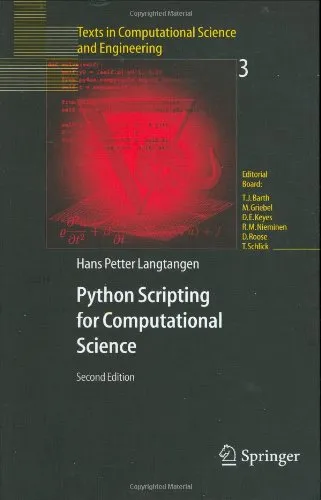
Numerical Solution of Partial Differential Equations on Parallel Computers
Hans Petter Langtangen
2005
View book

Book guide and evaluation
Pavel Ŝolín
0 reviews
Published
pages
views
Introduction to Partial Differential Equations and the Finite Element Method Welcome to the intricate world of Partial Differential Equations and the Finite Element Method, a domain where mathematics meets computational efficiency to tackle real
Before you read
Welcome to the intricate world of Partial Differential Equations and the Finite Element Method, a domain where mathematics meets computational efficiency to tackle real-world problems. This book serves as a comprehensive guide for both beginners and seasoned practitioners in understanding and applying these powerful tools in various scientific and engineering contexts.
The book begins with a thorough introduction to partial differential equations (PDEs), explaining their significance in modeling a diverse range of phenomena in physics, engineering, and beyond. The core aspects of PDEs, such as classification, well-posedness, and boundary conditions, are explored meticulously.
Moving from theory to application, this book delves into the finite element method (FEM), a numerical technique for finding approximate solutions to PDEs. Readers are guided through the mathematical foundations of the FEM, starting with variational methods and proceeding to discretization strategies.
As the chapters progress, the book balances theory with practice, providing algorithmic insights and practical computational techniques. It emphasizes the implementation of FEM in real-world scenarios, utilizing a step-by-step approach that demystifies complex concepts. Attention is given to error analysis and the convergence properties of solutions, equipping readers with the knowledge to evaluate the accuracy of their computational results.
This volume concludes with advanced topics, including time-dependent problems and non-linear PDEs, reflecting the versatility of the FEM in handling diverse challenges. Detailed examples and exercises throughout the book enrich the learning experience, establishing a robust understanding of both PDEs and FEM.
"In the realm of mathematics and computation, partial differential equations stand as the bridge between theoretical constructs and tangible realities."
"The finite element method unveils the secret to solving the unsolvable, transforming abstract equations into practical solutions."
This book is an essential resource for anyone interested in the intersection of mathematics, engineering, and computer science. It demystifies two of the most important tools in the field of numerical analysis: partial differential equations and the finite element method.
By providing comprehensive coverage of both fundamental concepts and advanced techniques, it equips readers with the skills necessary to approach complex problems with confidence and precision. Whether you're a student seeking to deepen your understanding or a professional looking to enhance your computational toolkit, this book offers invaluable insights, making it a crucial addition to your library.
Moreover, the emphasis on practical implementation ensures that the knowledge gained is not merely theoretical but also applicable in real-world scenarios. This bridge from theory to practice is what makes 'Partial Differential Equations and the Finite Element Method' a cornerstone in the education of modern mathematicians, engineers, and scientists.
Your question is answered in the context of this title and author. Each answer uses 2 points.
0 reviews, 4.5 average out of 5
Sign in to publish a review.
Ask a focused question and learn from the community.
Related references that continue this learning path.
Hans Petter Langtangen
Sylvie Benzoni-Gavage,Denis Serre