Book guide and evaluation
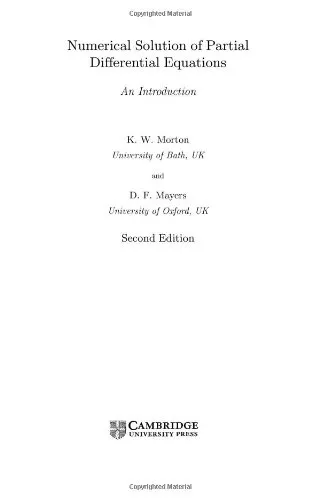
Numerical Solution of Partial Differential Equations: An Introduction
K. W. Morton
English
Beginner
Mathematics
4.5 / 5
0 reviews
2005
Published
293
pages
494
views
Introduction Welcome to 'Numerical Solution of Partial Differential Equations: An Introduction', a comprehensive guide to understanding the fundamental principles and techniques used in solving partial differential equations (PDEs) numerically. This book serves as
Before you read
What will you get from this book?
Introduction
Welcome to 'Numerical Solution of Partial Differential Equations: An Introduction', a comprehensive guide to understanding the fundamental principles and techniques used in solving partial differential equations (PDEs) numerically. This book serves as an essential reference for students, researchers, and professionals who wish to deepen their understanding of numerical methods and their applications in solving real-world problems modeled by PDEs.
Detailed Summary of the Book
The book begins with a solid foundation in the basic concepts of partial differential equations, ensuring that even readers with minimal prior knowledge can follow along. Emphasis is placed on theoretical insights and practical implementation, bridging the gap between abstract mathematical concepts and tangible computational techniques. Readers will explore a variety of topics, such as finite difference methods, finite element methods, and spectral methods, all of which are pivotal in the computational analysis of PDEs.
Structured progression through the material allows readers to progressively develop their understanding. Key aspects of initial and boundary value problems are rigorously discussed, helping readers grasp how these challenges can be addressed using numerical approximations. In subsequent chapters, the book delves deeper into stability, consistency, and convergence, ensuring that readers have a robust framework for evaluating the effectiveness of numerical solutions.
Each chapter is interspersed with detailed examples, illustrative diagrams, and problems of varying complexity, promoting hands-on practice and reinforcing key concepts. By the end of the book, readers will have acquired a versatile toolkit of numerical methods applicable to a wide spectrum of fields including physics, engineering, finance, and beyond.
Key Takeaways
- Comprehensive coverage of the numerical methods used to solve PDEs.
- Clear explanation of finite difference, finite element, and spectral methods.
- Insight into the theoretical foundation and practical implementation of numerical solutions.
- Hands-on examples and exercises to reinforce understanding.
- Useful for students and professionals across diverse scientific and engineering disciplines.
Famous Quotes from the Book
"The art of solving partial differential equations lies in balancing the underlying theory with computational expedience."
"In the realm of numerical solutions, understanding the nature of the approximate solutions is as critical as the mathematical formulation itself."
Why This Book Matters
The importance of this book lies in its clarity and depth, providing a well-rounded introduction to an otherwise complex subject matter. As numerical methods continue to spearhead advancements in computational technologies and industries, mastery of these techniques becomes invaluable. 'Numerical Solution of Partial Differential Equations: An Introduction' equips readers with critical skills and knowledge, laying a foundation for innovative solutions in technology, science, and engineering domains.
For academia, this book serves as a trusted course material, guiding students through the myriad of numerical techniques with clarity and consistency. For professionals, it offers a bridge to enhance their proficiency in applying these methods to solve complex, non-linear problems encountered in their fields. Overall, this book stands as a significant contribution to the literature on partial differential equations and their numerical solutions, supporting the continued evolution of scientific and engineering problem-solving.
Ask this book
Your question is answered in the context of this title and author. Each answer uses 2 points.
Sign in to ask the book assistant.
Reader reviews
0 reviews, 4.5 average out of 5
No reviews yet
If you have read this book, help the next reader with your experience.
Write a review
Sign in to publish a review.
Reader questions and answers
Ask a focused question and learn from the community.
Sign in to ask or answer a question.
No questions yet
Be the first to ask a clear, useful question.
What to read next
Related references that continue this learning path.
Ordinary and Partial Differential Equations: An Introduction to Dynamical Systems
John W. Cain,Angela M. Reynolds
2010
View book