
Optical Properties of Highly Transparent Solids
T. C. McGill (auth.),Shashanka S. Mitra,Bernard Bendow (eds.)
1975
View book
Book guide and evaluation
Joseph Shinar
0 reviews
Published
pages
views
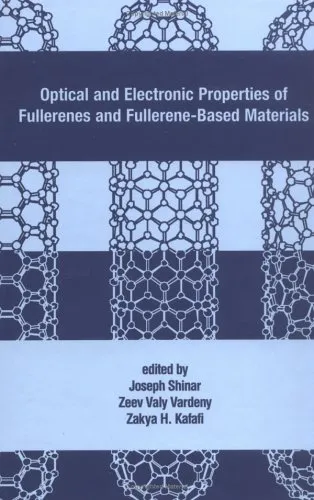
The book "Optical and Electronic Properties of Fullerenes and Fullerene-Based Materials" serves as a comprehensive guide to understanding the intricate world of fullerenes. These fascinating molecules, composed entirely of carbon, exhibit unique properties that hold immense
Before you read
The book "Optical and Electronic Properties of Fullerenes and Fullerene-Based Materials" serves as a comprehensive guide to understanding the intricate world of fullerenes. These fascinating molecules, composed entirely of carbon, exhibit unique properties that hold immense potential for numerous technological and scientific applications. Authored by Joseph Shinar, this volume delves deep into the structural intricacies, optical phenomena, and electronic behaviors of fullerenes and their derivatives. Designed for researchers, academics, and students, this book bridges the gap between complex theoretical concepts and their practical implementations.
The book unfolds with a thorough introduction to the basic structures and classifications of fullerenes. It details the molecular architecture of these carbon constructs, starting with the simplest form—C60. Known for their stability and unique hollow cage-like structures, fullerenes have intrigued scientists since their discovery. Joseph Shinar meticulously explores the synthesis processes, from arc discharge to chemical vapor deposition, providing insights into their scalability and the efficiency of each method.
One of the central themes elucidated is the optical properties of fullerenes. The book provides an extensive discussion on the absorption spectra, fluorescence, and phosphorescence of fullerene molecules. It highlights how their unique structures cause distinct interactions with light, thereby presenting potential applications in optoelectronic devices, organic solar cells, and light-emitting diodes.
Delving further, the electronic properties of fullerenes are examined. The text explores electron affinity, electrical conductivity, and the role of fullerenes as semiconductors. By understanding the electronic behaviors of these materials, readers gain insights into their applications in transistors, superconductors, and sensors.
The latter chapters address the development of fullerene-based materials. This includes composites and blends that enhance material properties such as durability, flexibility, and thermal stability. The book concludes with contemporary research findings, offering glimpses into future trends and innovations fueled by fullerene chemistry.
"In the realm of molecular magic, fullerenes epitomize the brilliance of carbon—a testament to nature’s architectural genius."
"The confluence of light and carbon in fullerenes opens a portal to future technologies, where energy and efficiency harmonize."
"Optical and Electronic Properties of Fullerenes and Fullerene-Based Materials" emerges as a pivotal text for multiple reasons. Fullerenes are not just a scientific curiosity but a burgeoning field of research with real-world applications ranging from renewable energy solutions to advanced electronic devices. By shedding light on both the fundamental and advanced concepts of fullerene chemistry and physics, this book aids researchers in pushing the boundaries of what is possible.
Significantly, the book is designed to cater to a diverse audience. Whether you're a seasoned researcher looking to enhance your understanding or a university student venturing into the field of material science, the book presents information with clarity and depth. Its impact is far-reaching, guiding readers through a novel material landscape that promises to revolutionize technology as we know it.
Your question is answered in the context of this title and author. Each answer uses 2 points.
0 reviews, 4.5 average out of 5
Sign in to publish a review.
Ask a focused question and learn from the community.
Related references that continue this learning path.
T. C. McGill (auth.),Shashanka S. Mitra,Bernard Bendow (eds.)
H. Jones (auth.),Sol Nudelman,S. S. Mitra (eds.)
Weinong W. Chen (auth.),Tom Proulx (eds.)
Daniel Knorr,Andrew Schoch,Joseph L. Lenhart (auth.),Vijay Chalivendra,Bo Song,Daniel Casem (eds.)