
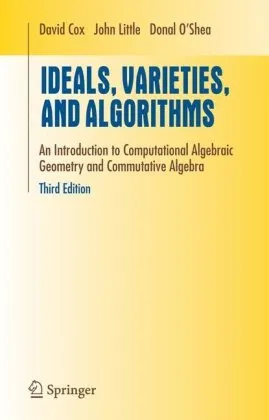
Ideals, varieties, and algorithms: an introduction to computational algebraic geometry and commutative algebra
David A. Cox,John Little,Donal O’Shea
2007
View book
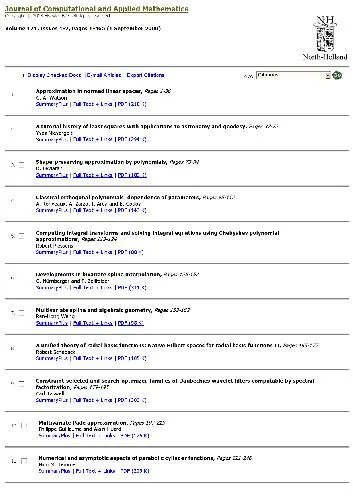
Book guide and evaluation
Wuytack L.
0 reviews
Published
pages
views
Welcome to the world of numerical analysis, a branch of mathematics that plays an indispensable role in the practical application of mathematical modeling, computations, and simulations. "Numerical Analysis 2000: Approximation Theory" is a comprehensive guide that delves deep
Before you read
Welcome to the world of numerical analysis, a branch of mathematics that plays an indispensable role in the practical application of mathematical modeling, computations, and simulations. "Numerical Analysis 2000: Approximation Theory" is a comprehensive guide that delves deep into approximation methods that are crucial for solving numerous real-world problems across various domains.
Written by experts in the field, this book serves as an essential resource for students, researchers, and professionals who aim to understand the intricacies of approximation theory within numerical analysis. The text is structured to benefit not only those who are new to the field but also advanced practitioners looking to deepen their knowledge. Covering a range of topics, the book starts with the basic concepts and theories that form the foundation of numerical approximation. It progresses to more advanced topics, including polynomial and rational approximation, orthogonal polynomials, and the least squares approximation technique.
One of the distinguishing features of this book is its focus on the computational aspects of approximation theory. The authors emphasize algorithmic approaches, ensuring that readers not only grasp theoretical concepts but also learn how to apply these theories effectively using modern computational tools. Each section is complemented by examples and exercises that guide the reader through the problem-solving process, enhancing both understanding and proficiency in approximation techniques.
At the conclusion of "Numerical Analysis 2000: Approximation Theory," readers will have gained a solid understanding of:
The book is replete with insights and reflections that have resonated with its readers:
"Approximation is at the heart of numerical analysis, serving as a bridge between abstract mathematical concepts and their practical applications."
"In every mathematical problem, there lies the potential for simplification, which is artfully realized through approximation techniques."
"Numerical Analysis 2000: Approximation Theory" is more than just a textbook; it's a vital resource that bridges the gap between mathematical theory and practical application. In a world where computational methods continue to advance and influence all scientific disciplines, understanding approximation is crucial for anyone engaged in mathematical modeling or data analysis. This book provides readers with not only the theoretical knowledge but also the practical skills needed to solve complex problems in science, engineering, and beyond.
Its impact is felt across many fields, including physics, engineering, computer science, and finance, where approximations enable the simplification of models, making solutions feasible when exact solutions are unattainable. Furthermore, as technology and methods rapidly evolve, the book's emphasis on computational techniques ensures that readers are prepared to tackle contemporary challenges with confidence and sophistication. By combining rigorous theory with practical applications, this book stands as an authoritative reference in the field of numerical analysis and approximation.
Your question is answered in the context of this title and author. Each answer uses 2 points.
0 reviews, 4.7 average out of 5
Sign in to publish a review.
Ask a focused question and learn from the community.
Related references that continue this learning path.
David A. Cox,John Little,Donal O’Shea
Michael T. Goodrich,Roberto Tamassia,Michael H. Goldwasser
Kent Lee,Steve Hubbard