Elementary Excitations in Solids, Molecules, and Atoms: Part A
P. W. Anderson (auth.),Jozef T. Devreese,A. B. Kunz,T. C. Collins (eds.)
1974
View book
Book guide and evaluation
0 reviews
Published
pages
views
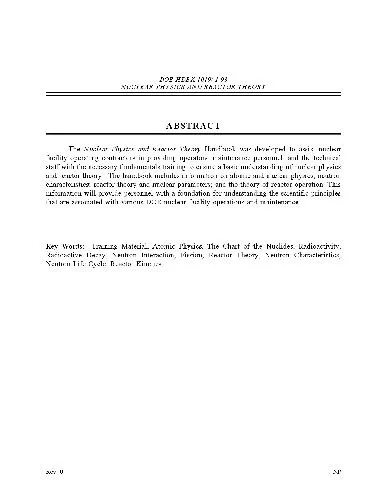
Introduction Welcome to a comprehensive journey through the intricate world of atomic and nuclear physics. This book, "Nuclear Physics and Reactor Theory. Module 1. Atomic and Nuclear Physics," serves as a foundational gateway for students, researchers, and enthusiasts k
Before you read
Welcome to a comprehensive journey through the intricate world of atomic and nuclear physics. This book, "Nuclear Physics and Reactor Theory. Module 1. Atomic and Nuclear Physics," serves as a foundational gateway for students, researchers, and enthusiasts keen on exploring the fundamental concepts and applications of nuclear physics. Designed with clarity and precision, this module aims to build a solid understanding of atomic structures, nuclear behavior, and the underpinning theories that guide today's nuclear endeavors. Utilizing a style that is both informative and reader-friendly, this book encapsulates decades of academic teaching and scientific exploration into manageable segments that facilitate learning and application.
This module is structured to introduce readers to the essential principles of atomic and nuclear physics, beginning with the basics of atomic theory and progressing to complex nuclear processes. Through systematic chapters, readers are guided from understanding the smallest particles that comprise matter—such as protons, neutrons, and electrons—to comprehending their interactions within atoms and nuclei. The book delves into atomic models, radioactive decay, nuclear reactions, and the forces that govern these phenomena.
One of the key features of this book is its focus on nuclear theory as it pertains to reactor design and operation. Readers will explore the laws of conservation, nuclear energetics, and reaction mechanisms, all of which are critical components in the field of nuclear engineering. Moreover, practical applications of these theories in reactor technology illustrate the profound impact of these scientific principles in real-world scenarios, particularly in energy production and medical applications.
The book concludes each chapter with a series of thought-provoking questions and problems designed to consolidate understanding and encourage further exploration of the topics covered.
"Understanding the atom is not only a scientific pursuit but a pathway to uncovering the immense potential within the subatomic world."
"Nuclear physics stands at the intersection of curiosity and innovation, driving the future of energy and technology."
In a rapidly advancing technological landscape, an understanding of nuclear physics is essential for anyone engaged in scientific research, policy-making, or education-related to energy and technology. "Nuclear Physics and Reactor Theory. Module 1. Atomic and Nuclear Physics" provides readers with the necessary knowledge to navigate and contribute to this vibrant field effectively.
This book is particularly relevant today as the world seeks sustainable energy solutions and grapples with the dual challenges of climate change and resource limitations. The role of nuclear physics in this context cannot be overstated. It offers robust solutions for clean energy while also paving the way for advancements in fields like medicine, where nuclear technology plays a critical role in diagnostics and treatment.
By equipping readers with both theoretical insights and practical applications, this book ensures that the next generation of scientists and engineers is well-prepared to handle the challenges and opportunities that lie ahead in the field of nuclear physics.
Your question is answered in the context of this title and author. Each answer uses 2 points.
0 reviews, 4.8 average out of 5
Sign in to publish a review.
Ask a focused question and learn from the community.
Related references that continue this learning path.
P. W. Anderson (auth.),Jozef T. Devreese,A. B. Kunz,T. C. Collins (eds.)