
From logic to art: themes from Nelson Goodman
Gerhard Ernst,Jakob Steinbrenner,Oliver R. Scholz (editors)
2009
View book
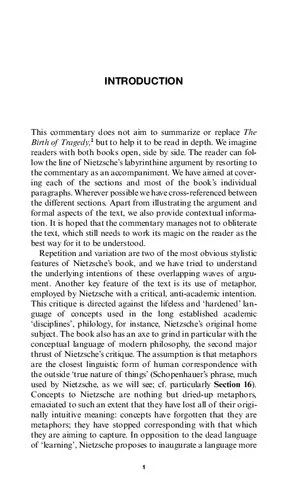
Book guide and evaluation
Douglas Burnham;Martin Jesinghausen
0 reviews
Published
pages
views
Introduction Nietzsche’s The Birth of Tragedy: A Reader’s Guide is an insightful companion to Friedrich Nietzsche's first major work, "The Birth of Tragedy". Co-authored by Douglas Burnham and Martin Jesinghausen, this guide provides readers with a thorough understanding o
Before you read
Nietzsche’s The Birth of Tragedy: A Reader’s Guide is an insightful companion to Friedrich Nietzsche's first major work, "The Birth of Tragedy". Co-authored by Douglas Burnham and Martin Jesinghausen, this guide provides readers with a thorough understanding of Nietzsche's exploration of Greek tragedy, culture, and philosophy. This guide not only unpacks the complexities within Nietzsche's original text but also situates the work within the broader context of his philosophical journey.
The guide offers a detailed analysis of "The Birth of Tragedy", discussing its key themes and Nietzsche's unique perspective on the origins and evolution of art and culture. The authors explore Nietzsche's distinction between the Apollonian and Dionysian elements of Greek tragedy, which he proposes as fundamental forces within art and life. The Apollonian represents order, logic, and individuality, while the Dionysian embodies chaos, passion, and a sense of unity. This dichotomy forms the backbone of Nietzsche's argument that life can be understood as an artistic phenomenon marked by a tension between these two forces. Burnham and Jesinghausen also shed light on Nietzsche's critique of Socratic rationalism and its perceived impact on the decline of tragic art. They delve into Nietzsche's reverence for the pre-Socratic period and his vision of a cultural rebirth, inspired by Dionysian elements and a reevaluation of artistic values.
The guide thoughtfully contextualizes and analyzes some of Nietzsche's most memorable statements, allowing readers to grasp their significance fully. Here are a few notable excerpts:
"What is the meaning of the tragic myth among the Greeks of the best, the strongest, the most courageous era?"
"The beautiful illusion of the dream worlds, in the creation of which every man is truly an artist."
"Perhaps the deepest understanding of Nietzsche lies in his claim that tragedy expresses the contradiction of life itself."
This reader’s guide is essential not only for students of philosophy and literature but also for anyone interested in understanding the profound cultural and aesthetic insights Nietzsche offers. By dissecting the nuances of "The Birth of Tragedy", Burnham and Jesinghausen provide readers with a comprehensive toolkit to engage with Nietzsche's philosophy more confidently. Their analysis is accessible yet profound, providing clarity on the complex interplay between art, culture, and philosophy that Nietzsche posits. Furthermore, by exploring Nietzsche's early thought processes, this guide sheds light on the intellectual trajectory that would culminate in his later, more mature works. It ignites deeper reflection on modern culture's artistic and cultural dimensions, making it a valuable resource for contemporary readers seeking to comprehend the undercurrents shaping human experience.
Your question is answered in the context of this title and author. Each answer uses 2 points.
0 reviews, 4.0 average out of 5
Sign in to publish a review.
Ask a focused question and learn from the community.
Related references that continue this learning path.
Gerhard Ernst,Jakob Steinbrenner,Oliver R. Scholz (editors)

Friedrich Nietzsche,Raymond Geuss,Ronald Speirs