Book guide and evaluation
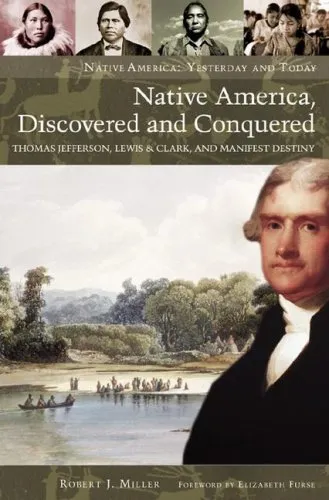
Native America, Discovered and Conquered: Thomas Jefferson, Lewis & Clark, and Manifest Destiny
Robert J. Miller
English
Advanced
Art
4.4 / 5
0 reviews
2006
Published
241
pages
411
views
Manifest Destiny, as a term for westward expansion, was not used until the 1840s. Its predecessor was the Doctrine of Discovery, a legal tradition by which Europeans and Americans laid legal claim to the land of the indigenous people that they discovered. In the United States, th
Before you read
What will you get from this book?
Manifest Destiny, as a term for westward expansion, was not used until the 1840s. Its predecessor was the Doctrine of Discovery, a legal tradition by which Europeans and Americans laid legal claim to the land of the indigenous people that they discovered. In the United States, the British colonists who had recently become Americans were competing with the English, French, and Spanish for control of lands west of the Mississippi. Who would be the discoverers of the Indians and their lands, the United States or the European countries? We know the answer, of course, but in this book, Miller explains for the first time exactly how the United States achieved victory, not only on the ground, but also in the developing legal thought of the day.The American effort began with Thomas Jefferson's authorization of the Lewis & Clark Expedition, which set out in 1803 to lay claim to the West. Lewis and Clark had several charges, among them the discovery of a Northwest Passage—a land route across the continent—in order to establish an American fur trade with China. In addition, the Corps of Northwestern Discovery, as the expedition was called, cataloged new plant and animal life, and performed detailed ethnographic research on the Indians they encountered. This fascinating book lays out how that ethnographic research became the legal basis for Indian removal practices implemented decades later, explaining how the Doctrine of Discovery became part of American law, as it still is today.
Ask this book
Your question is answered in the context of this title and author. Each answer uses 2 points.
Sign in to ask the book assistant.
Reader reviews
0 reviews, 4.4 average out of 5
No reviews yet
If you have read this book, help the next reader with your experience.
Write a review
Sign in to publish a review.
Reader questions and answers
Ask a focused question and learn from the community.
Sign in to ask or answer a question.
No questions yet
Be the first to ask a clear, useful question.
What to read next
Related references that continue this learning path.