
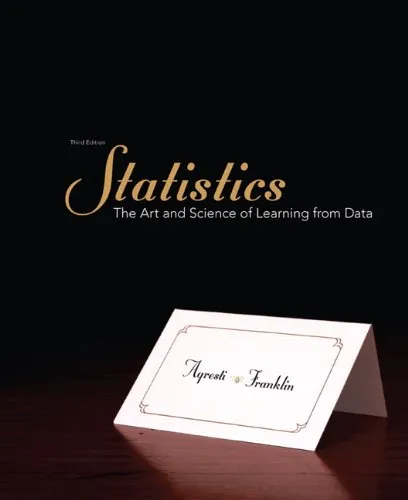
Statistics: The Art and Science of Learning from Data
Alan Agresti,Christine Franklin
2012
View book
Book guide and evaluation
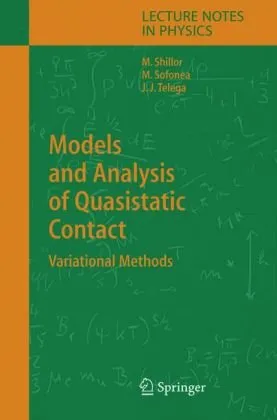
Meir Shillor,Mircea Sofonea,Józef Joachim Telega (auth.)
0 reviews
Published
pages
views
Welcome to the detailed introduction of the book 'Models and Analysis of Quasistatic Contact: Variational Methods'. This meticulously crafted work explores the mathematical models and variational tools required to study quasistatic contact problems within the field of solid mec
Before you read
Welcome to the detailed introduction of the book 'Models and Analysis of Quasistatic Contact: Variational Methods'. This meticulously crafted work explores the mathematical models and variational tools required to study quasistatic contact problems within the field of solid mechanics. Written by experts in the domain, the book offers readers a profound understanding of the subject, combining mathematical rigor with practical relevance.
This book is a comprehensive treatise on the modeling, analysis, and numerical treatment of quasistatic contact phenomena using variational methods. At its core, it tackles how mechanical systems behave under contact forces that vary slowly in time, focusing specifically on the complex interplay between deformation, stress distribution, and contact mechanics.
The work begins with an extensive introduction to mathematical techniques and fundamental principles of continuum mechanics vital for understanding contact phenomena. Building on this foundation, the authors delve into various contact models pertinent to elastic, viscoelastic, and other material responses. These models incorporate friction, adhesion, and wear in quasistatic scenarios.
A standout feature of the book is its rigorous use of variational and functional analysis methods to solve contact problems. The authors provide clear derivations of variational formulations for numerous problems stemming from unilateral constraints and boundary conditions. Furthermore, the text discusses modern numerical approaches, including finite element techniques, to approximate solutions and validate theoretical findings.
The book is structured for professionals and researchers in applied mathematics, engineering, and physical sciences. Its exhaustive treatment of contact mechanics makes it a go-to resource both for theoretical development and practical implementation. Each chapter is enriched with illustrative examples, lemmas, and proofs, ensuring readers from diverse scientific backgrounds can follow the content and apply it in their own work.
"Contact phenomena are central to the mechanics of solids, encompassing a wide range of practical and theoretical challenges."
"Variational methods provide a unifying framework for formulating and solving problems with unilateral constraints."
"The interplay between different models of friction and adhesion offers insights into real-world applications and advancements in material science."
'Models and Analysis of Quasistatic Contact: Variational Methods' is more than just a textbook—it addresses some of the most fundamental and applied problems in mechanics and offers a robust mathematical approach to resolving them. Its relevance spans multiple disciplines, including theoretical physics, materials science, and computational engineering.
The meticulous integration of variational techniques into the study of contact mechanics has profound implications for both research and practical applications. Engineers designing mechanical systems, scientists researching advanced materials, and mathematicians developing novel numerical algorithms will find this book invaluable.
Furthermore, the book helps readers appreciate the elegance of variational methods and their power in solving nonlinear problems subject to constraints. It serves as a bridge between mathematical theory and engineering design, encouraging interdisciplinary collaboration for solving contemporary challenges in solid mechanics.
Your question is answered in the context of this title and author. Each answer uses 2 points.
0 reviews, 4.0 average out of 5
Sign in to publish a review.
Ask a focused question and learn from the community.
Related references that continue this learning path.
Alan Agresti,Christine Franklin
Aswath Damodaran

Ralf Schneider,Amit Raj Sharma,Abha Rai (auth.),H. Fehske,R. Schneider,A. Weiße (eds.)