
Book guide and evaluation
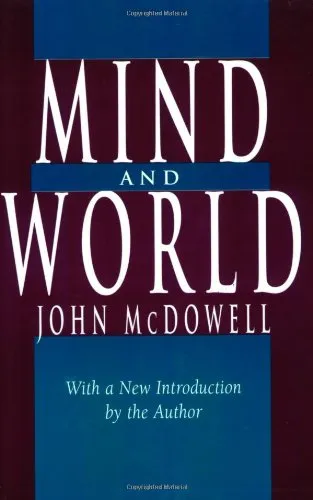
Mind and World: With a New Introduction
John McDowell
English
Beginner
Art
4.5 / 5
0 reviews
1996
Published
213
pages
418
views
Introduction to "Mind and World: With a New Introduction" "Mind and World: With a New Introduction" by John McDowell is an influential philosophical work that explores the complex interplay between two pivotal realms: human experience and the external world. This book st
Before you read
What will you get from this book?
Introduction to "Mind and World: With a New Introduction"
"Mind and World: With a New Introduction" by John McDowell is an influential philosophical work that explores the complex interplay between two pivotal realms: human experience and the external world. This book stands as a profound investigation into how our minds engage with reality, offering insights that bridge the gap between empirical science and philosophical inquiry.
Detailed Summary of the Book
"Mind and World" takes on the formidable task of untangling the intricate relationship between our thoughts and the world they purport to represent. McDowell argues against the conception of the human mind as a detached observer of the world, suggesting instead that our conceptual frameworks are intrinsically tied to our experiential access to the world itself.
The book is structured around a series of lectures known as the "John Locke Lectures," where McDowell eloquently counters the dualistic view of mind and world. He proposes a mediating role for what he terms "second nature," a concept that refers to our learned capacities to navigate the world effectively.
McDowell critiques the prevailing tendency to draw a stark line between nature and reason, challenging the notion that our cognitive faculties are isolated from our lived experiences. His philosophical approach suggests that human perception is not a passive reception of sensory data but an active process shaped by our engagement with the world. By invoking the concept of second nature, McDowell situates human understanding within the natural order, making room for a more integrated and less alienating vision of our cognitive practices.
Key Takeaways
- The mind interacts dynamically with the world, rather than passively observing it.
- Understanding is woven into the fabric of our everyday experience and actions.
- Conceptual thinking is rooted in our second nature, thus bridging the gap between natural and rational realms.
- Perception is both an empirical and a conceptual activity.
Famous Quotes from the Book
"We are less at the mercy of brute contingencies than the received picture has it."
"Experience must constitute a tribunal through which the world meets our spontaneity."
Why This Book Matters
John McDowell's "Mind and World" is foundational for those interested in the philosophy of mind, epistemology, and the nature of human understanding. It challenges the bifurcation of reason and empirical reality, advocating for a richer and more cohesive picture of human cognition. The book has profound implications for how we perceive our interaction with the world, influencing disciplines that extend beyond philosophy, such as cognitive science, psychology, and even artificial intelligence.
McDowell’s work resonates with readers who seek to understand the philosophical underpinnings of how we engage with the world, encouraging the reconsideration of age-old dichotomies. His call to integrate the philosophical inquiry with our lived experiences positions the book as a pivotal point of reflection for anyone grappling with the connections between thought, language, and reality.
Ask this book
Your question is answered in the context of this title and author. Each answer uses 2 points.
Sign in to ask the book assistant.
Reader reviews
0 reviews, 4.5 average out of 5
No reviews yet
If you have read this book, help the next reader with your experience.
Write a review
Sign in to publish a review.
Reader questions and answers
Ask a focused question and learn from the community.
Sign in to ask or answer a question.
No questions yet
Be the first to ask a clear, useful question.
What to read next
Related references that continue this learning path.
Husserl’s Logical Investigations in the New Century: Western and Chinese Perspectives
Kwok-Ying Lau (editor),John J. Drummond (editor)
2007
View book
Synthesis and Backward Reference in Husserl’s Logical Investigations
Jay Lampert (auth.)
1995
View book