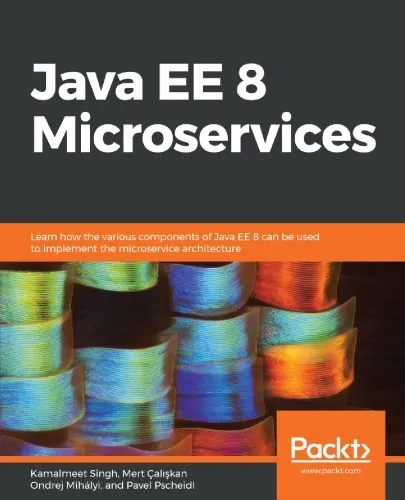
Java EE 8 Microservices - Learn how the various components of Java EE 8 can be used to implement the microservice architecture.
Kamalmeet Singh,Pavel Pscheidl et al.
2020
View book
Book guide and evaluation
Fiodar Sazanavets
0 reviews
Published
pages
views
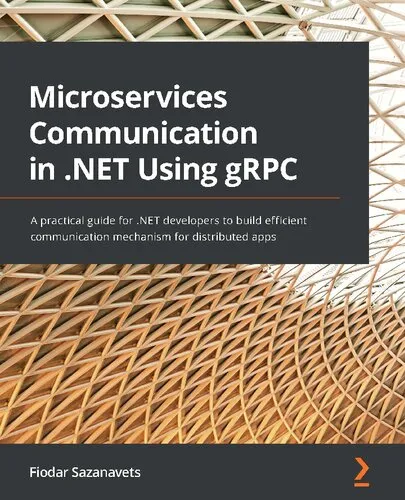
Introduction to “Microservices Communication in .NET Using gRPC” Welcome to “Microservices Communication in .NET Using gRPC: A practical guide for .NET developers to build efficient communication mechanism for distributed apps”. In today’s fast-paced world of software deve
Before you read
Welcome to “Microservices Communication in .NET Using gRPC: A practical guide for .NET developers to build efficient communication mechanism for distributed apps”. In today’s fast-paced world of software development, microservices architecture has emerged as the de facto standard for building resilient and scalable applications. As developers seek ways to enhance communication between distributed services, gRPC has become a frontrunner due to its high performance, efficient serialization, and support for bidirectional streaming. This book is your hands-on guide to mastering gRPC in the .NET ecosystem, empowering you to create robust and cutting-edge microservices communication mechanisms.
This book equips .NET developers with the knowledge required to design and build seamless microservices communication using gRPC. It starts by providing a solid foundation of microservices concepts and the challenges associated with inter-service communication. From there, the focus shifts to gRPC—a high-performance, open-source RPC framework developed by Google. The book demystifies gRPC fundamentals while guiding readers through practical implementations tailored to .NET applications.
You’ll explore how gRPC enables highly efficient, lightweight communication compared to traditional methods like HTTP-based REST APIs. The book covers all aspects of gRPC, from basic usage and protocol buffer definitions to integrating gRPC with ASP.NET Core projects. Advanced topics such as authentication, security, versioning, and streaming are also discussed in detail, ensuring readers build real-world-ready solutions.
Each chapter strikes a balance between theory and practice, providing clear explanations supplemented by hands-on coding examples. Whether you are developing new microservices or migrating existing monolithic applications, this book delivers actionable insights tailored to .NET professionals.
“Efficiency in microservices communication is not about reducing the amount of messages exchanged—it's about optimizing the way they’re delivered and understood.”
“Choosing the right communication protocol is pivotal. It’s not just about performance; it’s about sustainability and scaling as your application evolves.”
“gRPC and .NET are like two well-tuned gears—perfectly designed to create highly synchronized and efficient systems when paired together.”
This book is not just another technical guide—it’s a roadmap to professional growth for .NET developers. In the evolving software landscape, mastering microservices communication is an indispensable skill. Unlike many competing frameworks, gRPC is uniquely equipped to handle the demands of modern distributed systems with unmatched efficiency. By understanding how to use gRPC effectively within .NET applications, developers can push boundaries, build world-class systems, and optimize the performance of large-scale applications.
Furthermore, the book addresses key pain points faced by developers when transitioning to microservices architectures, such as security, scalability, and compatibility. It provides practical solutions that align with best practices and industry standards. Whether you're an experienced developer upgrading your microservices knowledge or a newcomer eager to learn, this book serves as a comprehensive toolkit for building reliable and maintainable systems. It bridges the gap between theory and hands-on application, making complex concepts accessible and approachable.
Your question is answered in the context of this title and author. Each answer uses 2 points.
0 reviews, 4.5 average out of 5
Sign in to publish a review.
Ask a focused question and learn from the community.
Related references that continue this learning path.
Kamalmeet Singh,Pavel Pscheidl et al.