

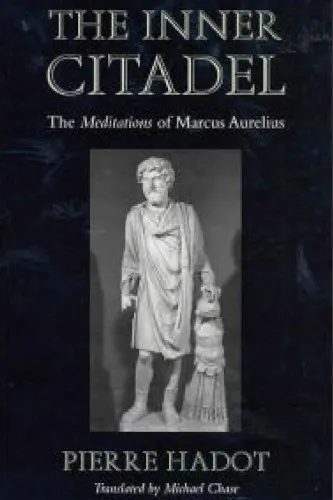
Book guide and evaluation
Meditations of Marcus Aurelius
Pierre Hadot, Michael Chase
English
Unordered
Unordered
4.4 / 5
0 reviews
2001
Published
0 / 368
pages
103
views
The Meditations of Marcus Aurelius are treasured today--as they have been over the centuries--as an inexhaustible source of wisdom. And as one of the three most important expressions of Stoicism, this is an essential text for everyone interested in ancient religion and philosophy
Before you read
What will you get from this book?
The Meditations of Marcus Aurelius are treasured today--as they have been over the centuries--as an inexhaustible source of wisdom. And as one of the three most important expressions of Stoicism, this is an essential text for everyone interested in ancient religion and philosophy. Yet the clarity and ease of the work's style are deceptive. Pierre Hadot, eminent historian of ancient thought, uncovers new levels of meaning and expands our understanding of its underlying philosophy.Written by the Roman emperor for his own private guidance and self-admonition, the Meditations set forth principles for living a good and just life. Hadot probes Marcus Aurelius's guidelines and convictions and discerns the hitherto unperceived conceptual system that grounds them. Abundantly quoting the Meditations to illustrate his analysis, the author allows Marcus Aurelius to speak directly to the reader. And Hadot unfolds for us the philosophical context of the Meditations, commenting on the philosophers[...]Marcus Aurelius read and giving special attention to the teachings of Epictetus, whose disciple he was.The soul, the guiding principle within us, is in Marcus Aurelius's Stoic philosophy an inviolable stronghold of freedom, the "inner citadel." This spirited and engaging study of his thought offers a fresh picture of the fascinating philosopher-emperor, a fuller understanding of the tradition and doctrines of Stoicism, and rich insight on the culture of the Roman empire in the second century. Pierre Hadot has been working on Marcus Aurelius for more than twenty years; in this book he distills his analysis and conclusions with extraordinary lucidity for the general reader.Reviews:The Meditations of Marcus Aurelius has been a popular text since the sixteenth century, and is a vital source in understanding the ideas of the Stoic School. Hadot seeks to demonstrate the context and background to Marcus Aurelius's writings, and helps to explain them to a modern readership. He makes the crucial point that Stoics considered the sole purpose of studying philosophy was to improve one's moral conduct. Hence Marcus's writings are in the form of a personal journal designed to develop the practice of acting morally and reflectively...Throughout the book Hadot stresses the depth of Stoic thought, and the interest it holds for modern philosophy...I would particularly recommend this book to those whose education in Ancient Philosophy has centred on Plato and Aristotle, and who are interested in finding out how their ideas were developed by later philosophers. (Matthew Clark JACT Review)In The Inner Citadel, Hadot applies to Marcus Aurelius' Meditations his characteristic interpretive approach: treating ancient philosophy as a 'way of life,' in particular one which provides its students with 'spiritual exercises' to enable them to make progress towards wisdom, and treating ancient philosophical texts with attention to the 'forms of discourse,' or constraints of genre, tradition, and audience that affected their production...The Inner Citadel is a rich and substantial book and will certainly affect future scholarship on Marcus Aurelius. (Rachana Kemtekur Bryn Mawr Classical Review)Hadot probes Marcus Aurelius's guidelines and convictions and discerns the until now unperceived conceptual system that grounds them. Abundantly quoting the Meditations to illustrate his analysis, he allows Marcus Aurelius to speak directly to us. Hadot unfolds for us the general philosophical context of the Meditations, commenting on the philosophers Marcus Aurelius read and giving special attention to the teachings of Epictetus, whom Marcus followed closely...Hadot's study offers a fresh picture of the fascinating philosopher-emperor, a fuller understanding of theories and doctrines of Stoicism, and rich insight on the culture of the Roman empire in the second century. Hadot has been working on Marcus Aurelius for more than twenty years; in this book he distills his analysis and conclusions with extraordinary lucidity for the general reader and specialist. (Word Trade)Plato used to talk of philosopher-kings; Marcus Aurelius was something even better: He was a philosopher-emperor. The leader of the Roman Empire spent most of his life in troubling times, campaigning against the barbarians, dealing with conspiracy at home, even combatting an upstart cult that revered one of those Galilean wonder-workers. Yet the most powerful man in the world still managed to live the life of a Stoic, and to record his reflections on how we should live. Those meditations, as these inner pep talks are usually called, became one of the best-loved books of antiquity...This study--by a leading authority on Marcus--provides background matter and analysis of the main themes in the Meditations, as well as fresh translations of many of the sayings. (Washington Post Book World)
Ask this book
Your question is answered in the context of this title and author. Each answer uses 2 points.
Sign in to ask the book assistant.
Reader reviews
0 reviews, 4.4 average out of 5
No reviews yet
If you have read this book, help the next reader with your experience.
Write a review
Sign in to publish a review.
Reader questions and answers
Ask a focused question and learn from the community.
Sign in to ask or answer a question.
No questions yet
Be the first to ask a clear, useful question.
What to read next
Related references that continue this learning path.

Biology of the Fungal Cell
Nicholas P. Money (auth.),Professor Dr. Richard J. Howard,Professor Dr. Neil A. R. Gow (eds.)
2001
View book