
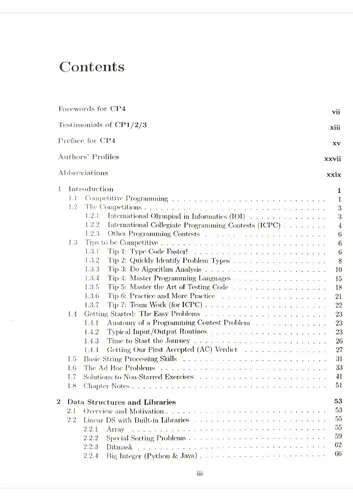
Competitive Programming 4: The Lower Bound of Programming Contests in the 2020s
Steven Halim,Felix Halim,Suhendry Effendy
2018
View book

Book guide and evaluation
Karthikeyan Ramamurthy,Andreas Spanias
0 reviews
Published
pages
views
Introduction to the Book "MATLAB Software for the Code Excited Linear Prediction Algorithm: The Federal Standard-1016" provides a comprehensive guide to understanding, implementing, and experimenting with the CELP (Code Excited Linear Prediction) algorithm using MATLAB. As
Before you read
"MATLAB Software for the Code Excited Linear Prediction Algorithm: The Federal Standard-1016" provides a comprehensive guide to understanding, implementing, and experimenting with the CELP (Code Excited Linear Prediction) algorithm using MATLAB. As part of the Federal Standard-1016, CELP is a cornerstone in the realm of speech coding standards designed for efficient digital transmission and storage of speech at low bit rates. This book is not only a technical walkthrough but also serves as a vital resource for engineers, researchers, and students who are eager to explore the nuances of speech coding technologies.
Authored by Karthikeyan Ramamurthy and Andreas Spanias, this synthesis lecture meticulously combines theoretical foundations, technical details, and practical MATLAB implementations. At its core, the text empowers readers to fully understand the algorithm's structure, its various components, and to efficiently implement it for research or engineering applications.
This book delves deep into the Code Excited Linear Prediction algorithm, a technique that has revolutionized speech compression. It not only explains the mathematical formulations behind CELP but also translates these concepts into a functional MATLAB-based framework to assist readers in exploring its practical applications. The book is organized to guide readers from the basics of speech signal processing to an in-depth analysis of CELP, covering its encoding and decoding processes, vector quantization, perceptual weighting, and pitch prediction.
The Federal Standard-1016 CELP algorithm is widely regarded for achieving high-quality speech transmission at low bitrates, which is critical in modern communication systems. The book provides MATLAB code snippets and examples, enabling readers to test and evaluate different sections of this algorithm independently or as a whole. Additionally, it includes performance analysis criteria to assess the quality of encoded speech.
Furthermore, the authors adopt an accessible approach by introducing readers to the fundamentals and slowly advancing to complex topics such as residual excitation and linear prediction coefficients (LPCs), ensuring that both novices and experienced professionals can benefit.
"Speech coding is not just about transmitting data; it is about transmitting audible experiences with minimal sacrifice in quality."
"The Federal Standard-1016 CELP is not merely an algorithm; it is a testament to how efficient engineering can impact communication globally."
The significance of this book lies in its precise focus on one of the most influential speech coding standards: the CELP algorithm. As communication systems continue to evolve, the demand for efficient data compression is more critical than ever. By decoding the Federal Standard-1016 CELP algorithm, the book contributes to a foundational understanding of how low-bitrate, high-quality speech transmission is achieved. This knowledge can be further extended to cutting-edge communication systems, including mobile telephony, voice over IP (VoIP), and even AI-driven speech processing.
In addition to its practical utility, the book fosters a deeper appreciation of combining mathematics, computer science, and engineering principles. It suits a diverse audience, from students studying digital signal processing to industry professionals optimizing codecs for modern applications.
What makes this book truly indispensable is its dual appeal: it is a learning tool for those new to MATLAB-based software development and a reference guide for seasoned engineers working on speech-centric software and hardware solutions.
Your question is answered in the context of this title and author. Each answer uses 2 points.
0 reviews, 4.0 average out of 5
Sign in to publish a review.
Ask a focused question and learn from the community.
Related references that continue this learning path.
Steven Halim,Felix Halim,Suhendry Effendy

Ralf Schneider,Amit Raj Sharma,Abha Rai (auth.),H. Fehske,R. Schneider,A. Weiße (eds.)