Book guide and evaluation
Mathematical Programming
A. Hordijk; L. C. M. Kallenberg
English
Unordered
Applied Mathematics
4.7 / 5
0 reviews
1984 September
Published
268
pages
1114
views
Mathematical Programmingpp.46—70 Optimization theory, Linear programming Explore Mathematical Programmingpp.46—70 with expert insights into advanced optimization and linear programming techniques. Analytical Summary The section entitled Mathematical Programmingpp.
Before you read
What will you get from this book?
Analytical Summary
The section entitled Mathematical Programmingpp.46—70 offers an intensive dive into the structural, theoretical, and computational aspects of mathematical programming. Written by A. Hordijk and L. C. M. Kallenberg, this segment is a vital chapter for anyone engaged in optimization theory, presenting tools and concepts that bridge academic insight with practical application.
Across these pages, readers encounter rigorous formulations of linear and nonlinear programming problems, alongside proofs and examples that illustrate fundamental principles. The authors employ precise mathematical language, ensuring clarity without oversimplification. This combination makes the text equally valuable to graduate students, academic researchers, and practitioners who need a solid theoretical backbone for real-world challenges.
Beyond theory, Mathematical Programmingpp.46—70 discusses algorithmic approaches, detailing the step-by-step construction of solutions. Emphasis is placed on method selection, convergence analysis, and computational efficiency—topics essential for translating theoretical constructs into actionable results.
Key Takeaways
This part of the book distills several key lessons that resonate with serious readers committed to mastering optimization and linear programming methods.
First, it underscores that a deep understanding of problem structure often dictates the success of solution strategies. The case studies within illustrate how subtle changes in constraints can dramatically alter outcomes.
Second, the authors highlight the interplay between mathematical abstraction and computational implementation. Readers are encouraged to balance analytical rigor with algorithmic pragmatism to achieve optimal solutions.
Third, the handling of examples demonstrates a consistent methodology—definition of the problem, formulation in mathematical terms, selection of an appropriate solving technique, and evaluation of results against criteria.
Memorable Quotes
The structure of a mathematical model is the key to unlocking its computational potential. Unknown
Optimization is not only about finding the best solution; it’s about understanding why it is the best. Unknown
The elegance of linear programming lies in its balance between complexity and solvability. Unknown
Why This Book Matters
Mathematical Programmingpp.46—70 stands as a targeted exploration within the broader field of mathematical programming literature, offering concentrated value in its focused span.
For optimization theorists, these pages distill decades of research into accessible yet sophisticated presentations. The emphasis on linear programming techniques reinforces the importance of foundational methods while paving the way for advanced applications.
Information unavailable on awards or first edition publication date as there is no reliable public source. This absence does not diminish the work's importance, as its academic rigor speaks for itself.
Inspiring Conclusion
Immersing yourself in Mathematical Programmingpp.46—70 is an invitation to refine your mastery of optimization and linear programming. Whether you are analyzing theoretical constructs or implementing algorithms in applied contexts, the insights here offer a clear path forward.
This text’s precision, combined with its practical emphasis, equips you to tackle complex problems with confidence. Engage with these pages deeply, share your interpretations with peers, and bring the principles into active discussion in your academic or professional circles. The next step is yours—read, reflect, and contribute to the evolving discourse on mathematical programming.
Ask this book
Your question is answered in the context of this title and author. Each answer uses 2 points.
Sign in to ask the book assistant.
Reader reviews
0 reviews, 4.7 average out of 5
No reviews yet
If you have read this book, help the next reader with your experience.
Write a review
Sign in to publish a review.
Reader questions and answers
Ask a focused question and learn from the community.
Sign in to ask or answer a question.
No questions yet
Be the first to ask a clear, useful question.
What to read next
Related references that continue this learning path.
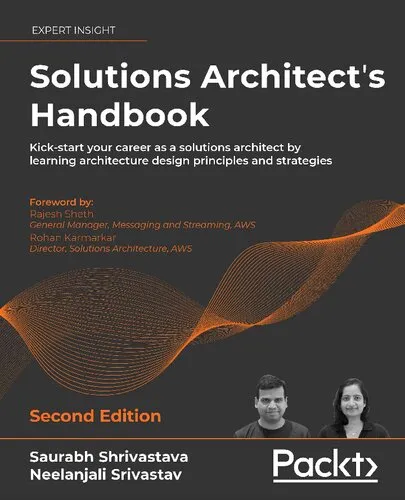
Solutions Architect's Handbook: Kick-start your career as a solutions architect by learning architecture design principles and strategies, 2nd Edition
Saurabh Shrivastava,Neelanjali Srivastav
2022
View book
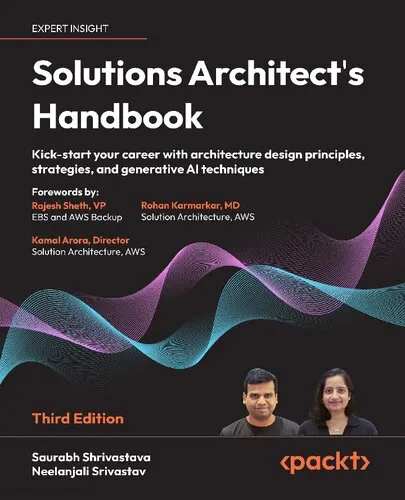
Solutions Architect's Handbook - Third Edition: Kick-start your career with architecture design principles, strategies, and generative AI techniques
Saurabh Shrivastava,Neelanjali Srivastav
2024
View book