
The Mathematical Experience, Study Edition
Philip J. Davis,Reuben Hersh,Elena Anne Marchisotto (auth.)
2012
View book
Book guide and evaluation
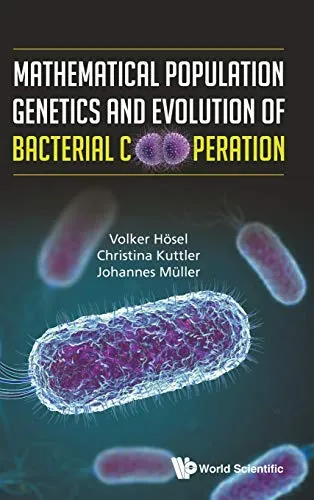
Volker Hosel,Christina Kuttler,Johannes Muller
0 reviews
Published
pages
views
Introduction to "Mathematical Population Genetics and Evolution of Bacterial Cooperation" "Mathematical Population Genetics and Evolution of Bacterial Cooperation" is a comprehensive exploration of the mathematical and theoretical underpinnings of populat
Before you read
"Mathematical Population Genetics and Evolution of Bacterial Cooperation" is a comprehensive exploration of the mathematical and theoretical underpinnings of population genetics with a deeply focused lens on bacterial systems. Authored by Volker Hosel, Christina Kuttler, and Johannes Müller, the book delves into the fascinating interplay between evolution, cooperation, and genetic dynamics within bacterial populations. Combining mathematics, biology, and evolutionary theory, it serves as an essential resource for researchers, academics, and students looking to build a strong foundation in these interconnected disciplines.
The book brings together rigorous mathematical modeling and real-world biological phenomena, delivering insights into how cooperation can arise, persist, or diminish within microbial communities. By adopting a multi-disciplinary perspective, the authors explore fundamental questions about how genetic factors, environmental constraints, and evolutionary strategies shape the behavior of bacterial populations. This synthesis of ideas offers readers both theoretical depth and practical tools for analyzing complex systems in microbial ecology and beyond.
At its core, the book focuses on explaining and modeling the genetic and evolutionary dynamics that govern bacterial cooperation. Through the use of mathematical frameworks, such as differential equations, game theory, and stochastic processes, the authors aim to decipher how cooperation evolves amidst competitive pressures in bacterial environments. Key concepts include horizontal gene transfer, quorum sensing, and biofilm formation—each of which plays a pivotal role in the cooperative behavior of microbes.
The chapters are carefully structured, moving from fundamental theoretical principles to applications in experimental biology. The authors first introduce readers to the basic mathematics used to model population genetics, such as Hardy-Weinberg equilibrium, mutation-selection balance, and fixation probabilities. They then transition to bacterial-specific contexts, grounding their models in biological phenomena like resource sharing, antibiotic resistance, and microbial public goods.
Readers are also exposed to cutting-edge research into how cooperation and conflict interplay within bacterial communities. The book discusses various evolutionary mechanisms that enable cooperation, such as kin selection, group selection, and reciprocity. At the same time, it addresses phenomena like the emergence of "cheater" strains that exploit cooperative systems, providing insight into the delicate balance maintained within these populations.
Beyond theoretical modeling, the book emphasizes practical applications. It explores how understanding bacterial cooperation can aid in the development of treatments for infectious diseases, strategies for combating antibiotic resistance, and the optimization of biotechnological processes involving microbial systems. This balance between theory and application makes the book a valuable resource for a wide audience.
"In the microcosm of bacterial life, cooperation is not just an ideal—it is a strategy, an evolutionary necessity, and often, a fragile balance."
"The mathematics of population genetics serves as a lens, revealing the unseen forces that sculpt the diversity of life on microscopic and macroscopic scales."
"Understanding bacterial cooperation is key to unlocking solutions to some of the biggest challenges in medicine and ecology."
Microbial systems have a profound impact on human health, ecosystems, and biotechnology. However, their population dynamics are notoriously complex, requiring a firm grasp of both biology and mathematics to unravel. "Mathematical Population Genetics and Evolution of Bacterial Cooperation" bridges this gap, offering a unified framework for understanding how cooperation evolves among bacterial populations. The book not only contributes to academic knowledge in population genetics but also provides actionable insights that can be applied to real-world challenges.
From the global battle against antibiotic resistance to the design of microbial consortia for industrial purposes, the themes explored in this book have far-reaching implications. By presenting rigorous mathematical models alongside tangible biological examples, the authors ensure that the content is accessible to both mathematicians and biologists. For anyone seeking to explore the nexus between evolution, genetics, and cooperation, this book is an indispensable resource.
Your question is answered in the context of this title and author. Each answer uses 2 points.
0 reviews, 4.5 average out of 5
Sign in to publish a review.
Ask a focused question and learn from the community.
Related references that continue this learning path.
Philip J. Davis,Reuben Hersh,Elena Anne Marchisotto (auth.)
National Research Council; Committee on DoctoralandPostdoctoral Study in the United States