
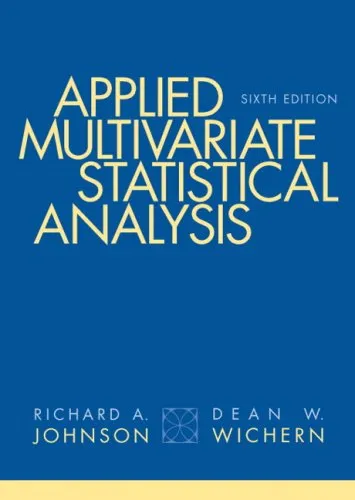
Applied Multivariate Statistical Analysis (6th Edition)
Richard A. Johnson,Dean W. Wichern
2007
View book

Book guide and evaluation
James C. Frauenthal (auth.)
0 reviews
Published
pages
views
Introduction to "Mathematical Modeling in Epidemiology" Epidemiology, the scientific study of how diseases spread and their effects on populations, plays a crucial role in public health policy, disease prevention, and healthcare planning. "Mathematical Modeling in Epidemio
Before you read
Epidemiology, the scientific study of how diseases spread and their effects on populations, plays a crucial role in public health policy, disease prevention, and healthcare planning. "Mathematical Modeling in Epidemiology" aims to bridge the gap between mathematics and epidemiology, enabling researchers, students, and practitioners to better understand how dynamic systems influence disease transmission and control strategies. This book provides a compelling introduction to essential mathematical concepts, tailored to their practical applications in the field of infectious diseases.
"Mathematical Modeling in Epidemiology" covers a variety of mathematical tools and techniques that help elucidate the dynamics of disease transmission. The book begins with an exploration of foundational epidemiological concepts, such as basic reproduction numbers, infection rates, and population dynamics, before delving into the mathematical frameworks necessary to model these phenomena.
The text introduces differential equations as a cornerstone for understanding the rate of infection in populations over time. Building on this, the book covers compartmental models such as the widely known SIR (Susceptible-Infectious-Recovered) model, and its extensions like SEIR (Susceptible-Exposed-Infectious-Recovered) models. By integrating real-world examples, it demonstrates how these frameworks can simulate various outbreaks and assist in designing and predicting the outcomes of interventions like vaccination campaigns or quarantine measures.
The book doesn't require advanced expertise in mathematics or epidemiology but instead provides the conceptual foundation to grasp the mechanics of disease spread. It also includes more advanced topics for deeper exploration, such as stochastic processes, sensitivity analysis, and long-term epidemic behavior.
By the end of the book, readers are equipped to apply their knowledge to analyze and construct their own models, making them not just passive readers but active problem solvers in global health crises.
"A well-constructed mathematical model is not only a theoretical tool but a language through which we can visualize and strategize the control of infectious diseases."
"Mathematical modeling transforms the unpredictable chaos of epidemics into patterns we can study, mitigate, and ultimately control."
"Understanding the mathematics behind disease spread empowers us to respond intelligently, rather than react impulsively, to the challenges of global health."
In the wake of global health challenges posed by infectious diseases such as COVID-19, Ebola, and SARS, understanding the science of disease modeling has never been more relevant. Public health officials, policy makers, healthcare providers, and researchers increasingly rely on mathematical models to guide their decisions. This book stands out by making the math accessible, bridging the gap between theoretical frameworks and practical applications.
It empowers readers from diverse disciplines—whether mathematics, biology, or public health—with the tools to understand, design, and refine mathematical frameworks in epidemiology. Beyond academic theory, the lessons in this book are immediately applicable to interventions that save lives and curb epidemics, highlighting its critical value for both education and public health.
Additionally, this book lays the foundation for further exploration into more complex scenarios, such as multi-host disease dynamics or systemic interactions within interconnected populations on a global scale. By engaging with this material, readers contribute to the effort of using science to improve lives and combat the spread of disease globally.
Your question is answered in the context of this title and author. Each answer uses 2 points.
0 reviews, 4.5 average out of 5
Sign in to publish a review.
Ask a focused question and learn from the community.
Related references that continue this learning path.
Richard A. Johnson,Dean W. Wichern
Richard A. Johnson,Dean W. Wichern

Richard Arnold Johnson,Dean W. Wichern
Howard E.A. Tinsley,Steven D. Brown