

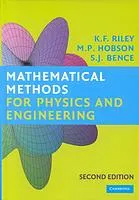
Book guide and evaluation
Mathematical Methods for Physics and Engineering: A Comprehensive Guide Third Edition
K. F. Riley,M. P. Hobson,S. J. Bence
English
Beginner
Physics
4.6 / 5
0 reviews
2006
Published
1363
pages
572
views
Introduction to 'Mathematical Methods for Physics and Engineering: A Comprehensive Guide (Third Edition)' Welcome to an in-depth exploration of the mathematical foundation essential for physicists and engineers alike. The third edition of "Mathematical Methods for Physics
Before you read
What will you get from this book?
Introduction to 'Mathematical Methods for Physics and Engineering: A Comprehensive Guide (Third Edition)'
Welcome to an in-depth exploration of the mathematical foundation essential for physicists and engineers alike. The third edition of "Mathematical Methods for Physics and Engineering: A Comprehensive Guide" is a meticulously structured and comprehensive text designed to bridge the gap between advanced mathematical ideas and their practical applications in the fields of physics and engineering. Authored by K. F. Riley, M. P. Hobson, and S. J. Bence, this definitive work is widely regarded as a cornerstone for students, researchers, and professionals seeking a rigorous and versatile resource.
Detailed Summary of the Book
The book is an extensive compendium, covering a diverse range of mathematical topics necessary for higher-level understanding in physics and engineering disciplines. Spanning fundamental concepts to advanced methods, the text progresses logically and systematically, ensuring readers build on solid foundational knowledge as they move toward more complex material.
Beginning with basic topics such as algebra, calculus, and vector analysis, the book gradually transitions into more specialized areas like differential equations, statistics, Fourier analysis, and complex variable theory. It also delves into sophisticated subjects such as tensor analysis, group theory, and the calculus of variations. Each chapter is crafted to integrate clear explanations, comprehensive examples, and practical applications, making it accessible and beneficial for students at varying levels of expertise.
The hallmark of this book is its clear organization. Each section begins with straightforward introductions to the topic and develops through worked examples, followed by problem sets that challenge readers to apply what they have learned. Mathematical rigor is consistently balanced with practical insight, creating a book that not only teaches concepts but also shows how mathematics underpins real-world physics and engineering challenges.
Key Takeaways
- The book provides a structured pathway from elementary mathematical techniques to advanced theoretical tools applicable to physics and engineering.
- Real-world applications are a central focus, ensuring mathematical methods are taught within a meaningful context.
- It includes detailed worked examples, exercises with solutions, and summaries that aid self-study and revision.
- The comprehensive coverage makes it a reliable single source for the diverse mathematical needs of students and professionals.
- Advanced topics, presented in an accessible style, prepare readers for specialized subfields such as quantum mechanics, fluid dynamics, and materials science.
Famous Quotes from the Book
"Mathematics is not merely a tool for describing nature but the language in which the universe is written. Our goal is to equip readers with the fluency to interpret and manipulate this language with confidence."
"While the complexity of theoretical physics and engineering can appear insurmountable, the right mathematical methods turn these challenges into solvable puzzles, fostering deeper understanding."
"Understanding a concept is incomplete without the ability to apply it. This is why every mathematical method here is supported by illustrative examples and applications."
Why This Book Matters
"Mathematical Methods for Physics and Engineering" is not just another technical text. It is a bridge between abstract mathematical theories and their tangible real-world applications. By crafting a resource that speaks to both physics and engineering students, the authors have ensured that the book stands as a unifying guide to the shared mathematical language of these disciplines.
The third edition goes beyond simply presenting methods—it fosters intuition and critical thinking, enabling readers to see the bigger picture and develop skills that extend beyond mathematics. This book matters because it empowers students to approach problems logically and analytically, making them more adept problem solvers in their respective fields.
For seasoned practitioners and researchers, this text serves as a comprehensive reference. Its clarity and structure ensure that even complex topics can be revisited with ease and confidence. The relevance of this book spans multiple generations as the principles of mathematics remain the foundation upon which scientific and engineering advancements are built.
Ask this book
Your question is answered in the context of this title and author. Each answer uses 2 points.
Sign in to ask the book assistant.
Reader reviews
0 reviews, 4.6 average out of 5
No reviews yet
If you have read this book, help the next reader with your experience.
Write a review
Sign in to publish a review.
Reader questions and answers
Ask a focused question and learn from the community.
Sign in to ask or answer a question.
No questions yet
Be the first to ask a clear, useful question.
What to read next
Related references that continue this learning path.
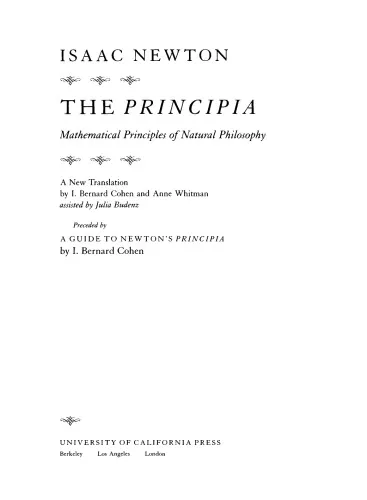
The Principia. Preceded by a guide to Newton's Principia by I. Bernard Cohen: mathematical principles of natural philosophy
Cohen, Ierome Bernard;Whitman, Anne;Newton, Isaac
1999
View book

Numerical Solution of Partial Differential Equations in Science and Engineering
Leon Lapidus,George F. Pinder
1999
View book